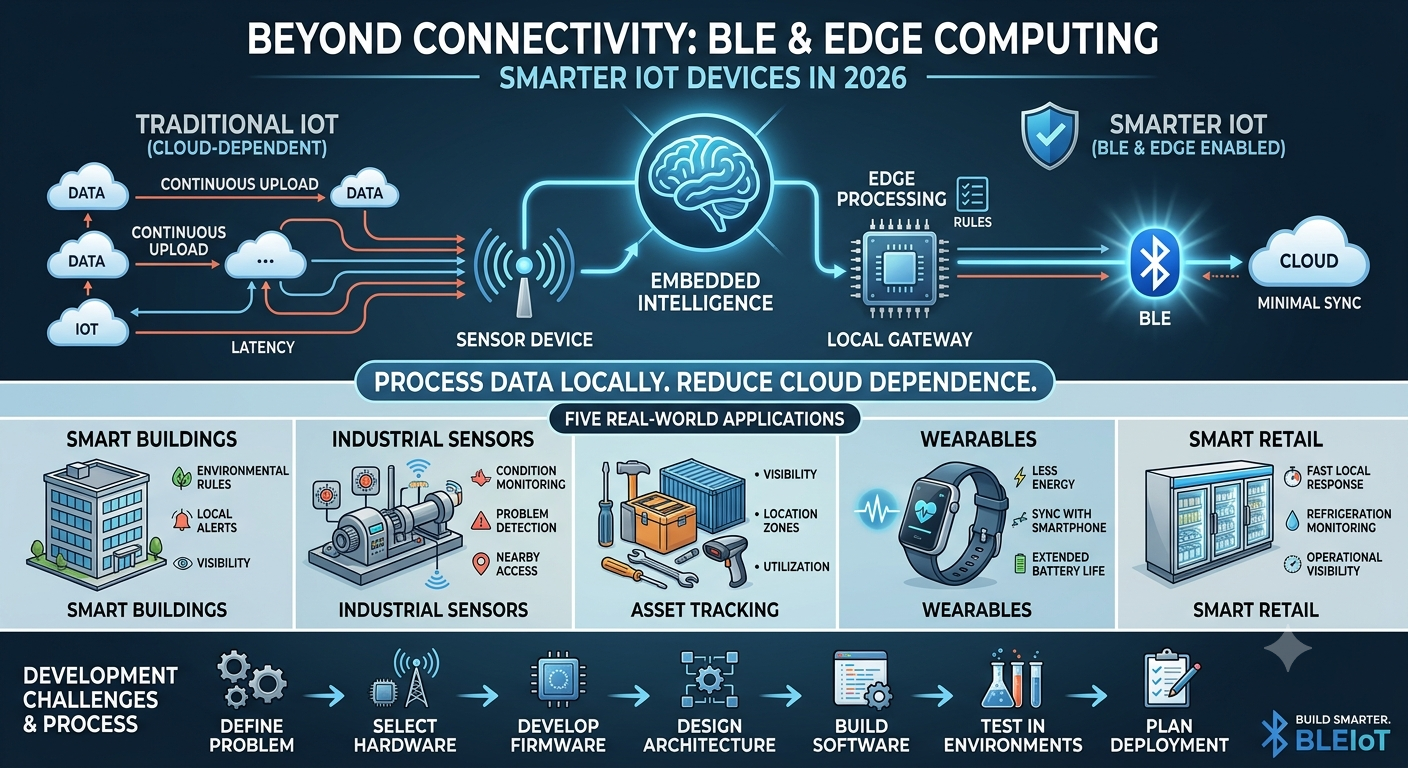
What if an IoT device could detect a problem, respond to a local event, and make a useful decision without sending every piece of data to the cloud?
This is one of the most interesting directions in connected product development in 2026. By combining Bluetooth Low Energy (BLE), embedded intelligence, and edge computing, businesses can build devices that communicate efficiently and respond to their surroundings with less dependence on continuous internet connectivity.
From smart buildings and industrial sensors to wearable technology and asset tracking, the opportunity is shifting from simply connecting devices to making those connections more useful.
For product developers, this means rethinking how devices collect information, process data, conserve energy, and communicate with the systems around them.
What Happens When IoT Devices Become More Intelligent?
Traditional IoT architectures often send sensor readings to a gateway or cloud platform for processing. This approach can be useful for centralized monitoring and large-scale analytics.
However, not every decision needs to travel through a remote server.
An intelligent edge device can process selected information locally, identify a relevant condition, and communicate only the necessary result.
Consider a temperature sensor installed in a commercial refrigerator. Instead of relying entirely on continuous cloud analysis, the device could detect when its temperature exceeds a configured threshold and trigger a local alert.
BLE could then help transmit readings or device status to a nearby smartphone or gateway.
The result is a more responsive architecture in which local processing and wireless connectivity serve different purposes.
Five Real-World Applications of BLE and Edge Computing
1. Smart Buildings That Respond to Their Environment
Commercial buildings contain numerous systems that monitor temperature, occupancy, lighting, and equipment conditions.
BLE-enabled sensors can help collect environmental information and communicate with compatible gateways or mobile devices.
Edge processing can support local rules, such as triggering a notification when a room becomes too warm or a monitored condition crosses a threshold.
Why it matters: Building operators can gain better visibility into environmental conditions and develop automation workflows suited to their facilities.
2. Industrial Sensors That Detect Problems Earlier
Industrial equipment can generate valuable information through vibration, temperature, pressure, and other measurements.
An edge-enabled sensor can evaluate selected readings locally and flag unusual patterns for further inspection.
BLE may support configuration, diagnostics, or nearby data access, while a gateway can relay information to a central monitoring platform.
Why it matters: This architecture can support condition monitoring and maintenance workflows without requiring every sensor to maintain a direct internet connection.
3. Asset Tracking Without Constant Manual Checks
Businesses frequently lose time locating tools, reusable containers, inventory, and other mobile assets.
BLE tags can broadcast identifying signals that compatible scanners or gateways detect. Software can use these observations to estimate proximity or identify the last detected zone.
Additional processing can help filter repeated detections and produce more useful asset-status information.
Why it matters: Better asset visibility can reduce search time and improve equipment utilization.
4. Wearables That Use Less Energy
Wearable devices must balance useful measurements with limited battery capacity.
Firmware can process selected sensor readings locally, reduce unnecessary transmissions, and synchronize relevant information with a mobile application.
BLE is particularly useful when a wearable needs to exchange relatively small amounts of data with a nearby smartphone.
Why it matters: Thoughtful data processing and communication scheduling can help extend battery life while preserving essential functionality.
5. Smart Retail Systems With Faster Local Responses
Retail businesses can use connected sensors to monitor refrigeration, equipment conditions, and selected environmental factors.
Local processing can trigger alerts when a monitored condition requires attention, while BLE can support device setup, diagnostics, or communication with nearby equipment.
Where remote monitoring is required, a gateway can send relevant information to a cloud dashboard.
Why it matters: Retail operators can improve operational visibility and respond to problems more quickly.
Why BLE Is Still Relevant in 2026
Bluetooth Low Energy remains useful because many IoT products do not need high-bandwidth communication at all times.
Its practical advantages include:
- Power efficiency: Suitable communication patterns can help battery-powered devices operate for longer periods.
- Smartphone compatibility: Many existing smartphones support BLE, simplifying certain setup and interaction workflows.
- Flexible architecture: BLE can work alongside gateways, cloud platforms, Wi-Fi, and cellular connectivity.
- Local communication: Devices can exchange supported information with nearby systems without requiring direct internet access.
- Broad application potential: BLE can support products ranging from wearables and sensors to configuration tools and asset tags.
Actual performance depends on the device design, communication intervals, radio environment, antenna, and implementation.
BLE vs. Wi-Fi vs. Edge Computing: Understanding Their Roles
These technologies are not direct substitutes for one another.
| Technology | Primary role | Common use case |
|---|---|---|
| BLE | Low-power wireless communication | Wearables, sensors, device setup |
| Wi-Fi | Network connectivity with higher throughput | Cameras, connected appliances, data-intensive devices |
| Edge computing | Local data processing | Alerts, sensor analysis, responsive automation |
| Cloud computing | Centralized storage and processing | Fleet management, reporting, historical analytics |
A single IoT product may use several of these technologies together.
For example, BLE can connect a sensor to a gateway, edge software can evaluate its readings, and cloud software can store historical data for reporting.
The right combination depends on the product’s range, power, latency, bandwidth, security, and cost requirements.
Six Engineering Challenges Developers Must Solve
An IoT product may work perfectly on a development bench but struggle in a real building or factory.
Successful development requires attention to several practical issues.
1. Battery optimization: Advertising intervals, connection parameters, sensor sampling, and firmware activity affect power consumption.
2. Wireless interference: Walls, metal objects, competing wireless signals, and device placement can affect communication reliability.
3. Data quality: Edge algorithms need suitable thresholds, reliable measurements, and testing against real operating conditions.
4. Device interoperability: Smartphone operating systems, Bluetooth stacks, and hardware implementations may behave differently.
5. Security: Authentication, access control, secure firmware updates, and protection of device data must be addressed throughout development.
6. Fleet management: Products deployed across many locations need maintainable firmware, reliable diagnostics, and practical update procedures.
Addressing these challenges early helps teams avoid costly redesigns and improve the reliability of deployed products.
How to Develop a BLE-Enabled Edge IoT Product
A structured process makes it easier to turn a product concept into a dependable solution.
Step 1: Define the actual problem
Determine what the device must measure, which decisions it needs to make, who will use it, and whether it must work without internet access.
Step 2: Select suitable hardware
Evaluate microcontrollers, BLE chipsets, sensors, battery requirements, memory, and processing capacity.
Step 3: Develop embedded firmware
Implement sensor acquisition, BLE communication, local processing, error handling, and power management.
Step 4: Design the communication architecture
Decide whether the product will communicate directly with a smartphone, through a gateway, or through a combination of local and remote systems.
Step 5: Build the supporting software
Develop the required mobile application, device-management dashboard, APIs, and cloud components.
Step 6: Test in realistic environments
Validate communication range, battery performance, reconnection behavior, sensor accuracy, security, and performance under expected operating conditions.
Step 7: Plan for deployment
Prepare device diagnostics, firmware maintenance, documentation, manufacturing requirements, and long-term support.
What Does the Future Hold for BLE and Edge IoT?
The next generation of connected products will increasingly combine efficient wireless communication with processing that happens closer to the source of the data.
AI-assisted anomaly detection, smarter sensor firmware, automated device diagnostics, and more responsive local workflows are promising areas of development.
However, not every device needs artificial intelligence or complex edge processing. Simple threshold-based rules may be more appropriate when they solve the problem reliably.
The best architecture is the one that delivers measurable value without adding unnecessary cost, complexity, or power consumption.
Build Smarter Connected Products With BLEIoT
Developing a successful IoT product requires more than selecting a wireless protocol. Hardware, firmware, connectivity, applications, security, and data processing must work together as one system.
BLEIoT can position its services around BLE-enabled product development, embedded firmware, sensor integration, mobile connectivity, and connected-device architectures tailored to business requirements.
Whether you are planning an industrial sensor, wearable, asset-tracking solution, or smart-building product, begin with the real-world problem and design the technology around it.
Have a connected product idea? Explore how BLE and edge computing can help turn it into a practical, efficient IoT solution.
Frequently Asked Questions
What is edge computing in IoT?
Edge computing processes data close to the device or where the data is generated, reducing the need to send every measurement to a remote cloud platform.
Can BLE work without the internet?
Yes. BLE devices can communicate locally with compatible devices without an internet connection. Remote monitoring usually requires an additional connection through a smartphone, gateway, or network-connected device.
Can BLE and edge AI work together?
Yes. A suitably capable device or nearby gateway can process sensor data locally and use AI models for supported tasks, depending on available computing resources.
Is BLE suitable for industrial IoT?
BLE can support industrial sensor monitoring, device configuration, diagnostics, and asset visibility when its range, reliability, and performance meet the application’s requirements.
How much does BLE IoT development cost?
Costs depend on hardware, firmware complexity, mobile applications, gateways, cloud integration, testing, manufacturing, and certification requirements.
Does every IoT device need a cloud platform?
No. Some products work entirely through local communication and processing. Cloud infrastructure becomes useful when remote access, centralized management, long-term storage, or multi-site reporting is required.