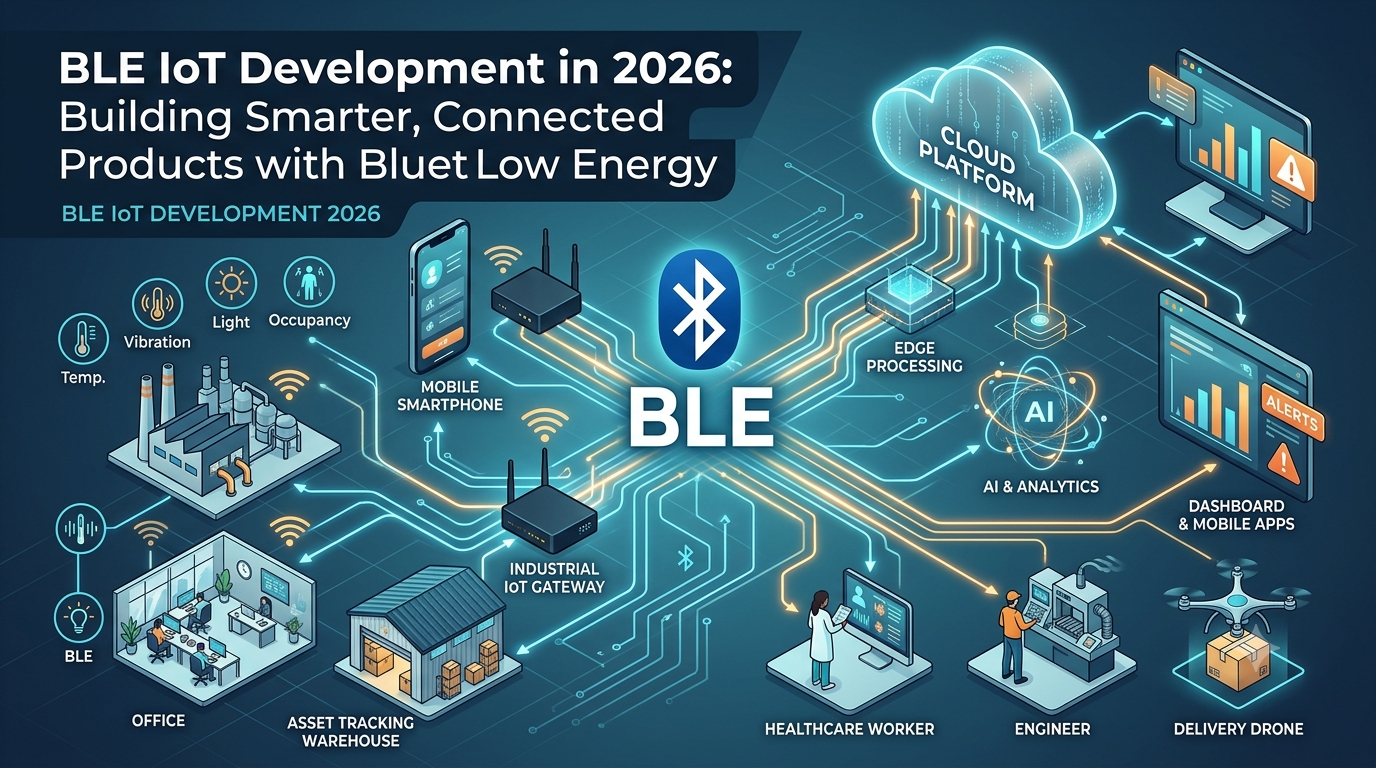
The Internet of Things is becoming more intelligent, connected, and practical for businesses across industries. From healthcare devices and smart buildings to retail systems, industrial equipment, fitness products, and asset tracking, connected products are changing how organizations collect and use real-time data.
At the center of many of these solutions is Bluetooth Low Energy (BLE).
BLE provides a low-power and flexible communication technology that allows devices, sensors, smartphones, gateways, and cloud platforms to exchange information efficiently.
In 2026, businesses are going beyond simple Bluetooth connectivity. They are building complete BLE IoT ecosystems that combine connected hardware, mobile applications, edge processing, cloud platforms, analytics, and AI.
What Is BLE IoT?
BLE IoT refers to the use of Bluetooth Low Energy technology to connect sensors, devices, and products as part of an Internet of Things ecosystem.
A typical BLE IoT solution can include:
- BLE-enabled sensors
- Connected devices
- Mobile applications
- BLE gateways
- Cloud platforms
- IoT dashboards
- APIs
- Data analytics
- AI and automation
For example, a temperature sensor can collect environmental information through BLE, send the data to a smartphone or gateway, and then transmit it to a cloud platform for monitoring and analysis.
This creates a complete flow:
Device → BLE → Gateway/Mobile App → Cloud → Analytics → Action
Why BLE Is Important for IoT Development
IoT devices often need to operate for long periods using limited battery power.
BLE was designed with low-power communication in mind, making it useful for connected products where energy efficiency is important.
Businesses can use BLE for applications where devices need to communicate periodically rather than maintain continuous high-bandwidth connections.
Key advantages include:
- Low power consumption
- Wireless connectivity
- Smartphone compatibility
- Compact hardware requirements
- Flexible communication
- Cost-effective connectivity
- Support for connected sensors and devices
BLE IoT Development Trends in 2026
BLE IoT development is moving toward smarter devices and more connected ecosystems.
1. BLE and AI
One of the biggest opportunities is combining BLE-generated data with AI.
BLE sensors can collect information about:
- Temperature
- Movement
- Location
- Proximity
- Equipment status
- Activity
- Environmental conditions
AI systems can then analyze this data to identify patterns, detect anomalies, and generate useful insights.
For example, an industrial system could use sensor data to identify unusual equipment behavior before a potential failure occurs.
This creates a powerful combination:
BLE Sensors + IoT Platform + AI = Intelligent Connected Products
2. Edge Computing
Sending every piece of sensor data to the cloud is not always efficient.
Edge computing allows certain processing tasks to happen closer to the device or gateway.
For BLE IoT applications, edge processing can help:
- Reduce latency
- Reduce unnecessary cloud traffic
- Improve responsiveness
- Support local decision-making
- Continue selected functions during connectivity interruptions
This can be especially useful for industrial, healthcare, and real-time monitoring applications.
3. BLE Asset Tracking
Asset tracking continues to be an important IoT use case.
BLE tags and beacons can help organizations monitor the location or proximity of equipment, inventory, tools, and other assets.
Businesses can combine BLE tracking with mobile applications, gateways, cloud platforms, and dashboards to create centralized visibility.
Potential applications include:
- Warehouse inventory
- Hospital equipment
- Manufacturing tools
- Retail assets
- Logistics
- Office equipment
- Industrial machinery
4. Smart Healthcare Devices
BLE is increasingly useful for connected healthcare and wellness products.
Devices can communicate with smartphones or dedicated gateways to transfer information such as:
- Heart-rate measurements
- Temperature
- Activity
- Movement
- Device status
- Other sensor readings
The resulting data can be displayed through mobile applications or connected to cloud platforms for authorized monitoring and analysis.
For healthcare applications, security, privacy, reliability, and applicable regulatory requirements must be considered from the beginning.
5. Smart Buildings
BLE IoT technology can also contribute to smarter buildings.
BLE-enabled devices can support applications such as:
- Occupancy monitoring
- Indoor positioning
- Access systems
- Environmental monitoring
- Smart lighting
- Asset tracking
- Room utilization
Connected building systems can combine BLE data with other IoT technologies to provide centralized operational insights.
6. Industrial IoT
Industrial environments contain large numbers of machines, sensors, and operational assets.
BLE can provide a practical communication layer for selected industrial IoT use cases.
Businesses can monitor:
- Equipment conditions
- Temperature
- Vibration
- Asset movement
- Maintenance indicators
- Operational environments
When connected to analytics platforms, this information can help organizations move toward predictive maintenance and more data-driven operations.
BLE IoT and Mobile Applications
Mobile applications are often an important component of BLE solutions.
A smartphone can act as a communication bridge between BLE devices and cloud systems.
A typical application architecture might look like:
BLE Device → Mobile App → API → Cloud Platform → Dashboard
The mobile application can:
- Discover BLE devices
- Establish connections
- Read sensor information
- Write configuration values
- Display real-time data
- Update device settings
- Send information to the cloud
- Manage connected devices
Developers need to carefully design BLE scanning, connection management, permissions, background operation, reconnection logic, and data synchronization.
BLE Gateway Development
A BLE gateway can connect local BLE devices with a broader IoT infrastructure.
For example:
BLE Sensors → BLE Gateway → Internet → Cloud Platform
This architecture can be useful when businesses need to collect information from many BLE devices without relying on a smartphone for every connection.
Gateways can also provide additional capabilities such as:
- Local processing
- Device management
- Data aggregation
- Cloud synchronization
- Remote monitoring
- Protocol conversion
BLE IoT Security
Security should be part of BLE IoT development from the beginning.
A connected product can involve multiple security layers:
Device → BLE Connection → Mobile/Gateway → API → Cloud → Dashboard
Potential security considerations include:
- Device authentication
- Secure pairing
- Encryption
- Access control
- API authentication
- Secure firmware updates
- Cloud security
- Data protection
- Device identity management
Developers should also consider what happens if a device is lost, compromised, replaced, or no longer authorized.
BLE Firmware and Over-the-Air Updates
Connected products often need firmware updates after deployment.
An effective BLE IoT ecosystem can support secure over-the-air firmware updates where appropriate.
OTA updates can help manufacturers:
- Fix software vulnerabilities
- Improve device functionality
- Resolve bugs
- Add features
- Improve performance
Firmware update processes should be carefully designed because an interrupted or corrupted update can potentially make a device unusable.
BLE IoT and Cloud Platforms
Cloud infrastructure allows organizations to manage and analyze information generated by connected devices.
A cloud-based BLE IoT platform can provide:
- Device registration
- Data storage
- Real-time monitoring
- Analytics
- Alerts
- User management
- Device configuration
- Reporting
- API access
Businesses can build web dashboards that allow authorized users to monitor connected devices from a centralized location.
BLE IoT Architecture
A scalable BLE IoT architecture typically consists of several layers.
Device Layer
This includes BLE-enabled sensors, tags, wearables, machines, and connected products.
Connectivity Layer
BLE provides local wireless communication between devices and smartphones or gateways.
Edge Layer
Gateways or edge devices can process and aggregate data locally.
Cloud Layer
The cloud platform stores, processes, and manages IoT data.
Application Layer
Mobile applications, web dashboards, analytics platforms, and enterprise systems allow users to interact with the connected ecosystem.
This layered architecture makes it easier to scale and maintain complex IoT solutions.
Industries Using BLE IoT Solutions
BLE IoT development can support a wide range of industries.
Healthcare
Connected medical and wellness devices, patient monitoring, and asset tracking.
Retail
Indoor positioning, inventory visibility, customer engagement, and smart retail experiences.
Manufacturing
Equipment monitoring, asset tracking, environmental sensing, and predictive maintenance.
Logistics
Asset tracking, warehouse monitoring, and supply-chain visibility.
Hospitality
Smart rooms, location services, asset management, and connected guest experiences.
Fitness and Wearables
Activity tracking, connected fitness equipment, and health-related sensors.
Smart Buildings
Occupancy monitoring, environmental sensors, access solutions, and facility management.
Challenges in BLE IoT Development
Despite its advantages, building a reliable BLE IoT solution requires careful engineering.
Device Compatibility
Different hardware manufacturers can implement BLE functionality differently. Developers need to thoroughly test across supported devices.
Connection Reliability
BLE connections can be affected by distance, interference, operating-system restrictions, and environmental conditions.
Battery Optimization
Developers must carefully manage advertising intervals, connection intervals, data transmission, and sleep modes.
Scalability
A prototype connecting a few devices may work very differently from a production system supporting thousands or millions of devices.
Data Management
Large IoT deployments can generate significant amounts of data. Businesses need an appropriate strategy for storage, processing, analytics, and retention.
How to Build a BLE IoT Product
A structured development process can reduce technical risks.
Step 1: Define the Use Case
Identify what the connected product needs to accomplish.
Step 2: Select Hardware
Choose appropriate BLE chips, sensors, gateways, and supporting components.
Step 3: Design BLE Communication
Define services, characteristics, data formats, connection behavior, and device interactions.
Step 4: Develop Firmware
Create the device software responsible for sensing, communication, power management, and device behavior.
Step 5: Build the Mobile or Gateway Application
Develop the software responsible for communicating with BLE devices and processing collected information.
Step 6: Connect the Cloud
Build APIs and cloud infrastructure for device management, data storage, analytics, and monitoring.
Step 7: Add Security
Implement appropriate authentication, encryption, authorization, and secure update mechanisms.
Step 8: Test at Scale
Test real-world connectivity, battery consumption, device compatibility, network conditions, security, and large-device deployments.
BLE IoT vs Traditional IoT Connectivity
BLE is not designed to replace every IoT connectivity technology.
The appropriate technology depends on the application.
BLE can be useful for short-range, low-power device communication.
Wi-Fi can provide higher bandwidth and direct network connectivity.
Cellular can support connected devices over wide geographic areas.
LoRaWAN can be useful for certain long-range, low-power IoT deployments.
Many real-world systems use multiple technologies together.
For example:
BLE Sensor → Gateway → Wi-Fi/Cellular → Cloud
This hybrid approach allows businesses to use each technology where it provides the greatest value.
The Future of BLE IoT Development
The future of BLE IoT will increasingly focus on intelligent connected products rather than isolated devices.
The combination of:
BLE + IoT + Edge Computing + Cloud + AI + Mobile
can create connected systems that not only collect information but also interpret it and trigger useful actions.
Manufacturers can build smarter products.
Businesses can gain better operational visibility.
Customers can receive more personalized experiences.
And connected devices can become part of larger digital ecosystems.
Final Thoughts
BLE continues to be an important connectivity technology for modern IoT development.
Its low-power characteristics, smartphone compatibility, flexibility, and broad range of use cases make it suitable for many connected-product applications.
But successful BLE IoT development requires more than connecting a sensor to a mobile phone.
Businesses need to consider hardware, firmware, BLE communication, mobile applications, gateways, cloud infrastructure, security, analytics, scalability, and long-term device management.
For companies planning a connected product, working with an experienced BLE IoT development partner can help turn an initial concept into a scalable and commercially viable solution.
Ready to build your connected product?
BLEIoT can help businesses develop BLE-powered IoT solutions that connect devices, applications, cloud platforms, and intelligent data-driven systems.