The Internet of Things is moving from simple connected devices toward smarter, more efficient, and increasingly intelligent ecosystems.
From healthcare wearables and industrial sensors to smart buildings, retail systems, asset tracking, and connected consumer products, businesses are looking for reliable technologies that can connect physical devices with software platforms.
One technology continuing to play an important role in this ecosystem is Bluetooth Low Energy (BLE).
When combined with IoT platforms, mobile applications, cloud services, and edge computing, BLE can provide a practical connectivity layer for products that need low-power wireless communication.
In 2026, BLE IoT development is becoming increasingly relevant for businesses building connected products and smart-device ecosystems.
What Is BLE IoT?
BLE IoT refers to the use of Bluetooth Low Energy technology within Internet of Things solutions.
BLE is designed for wireless communication while consuming relatively little power. This makes it particularly useful for devices that operate on batteries or need efficient short-range connectivity.
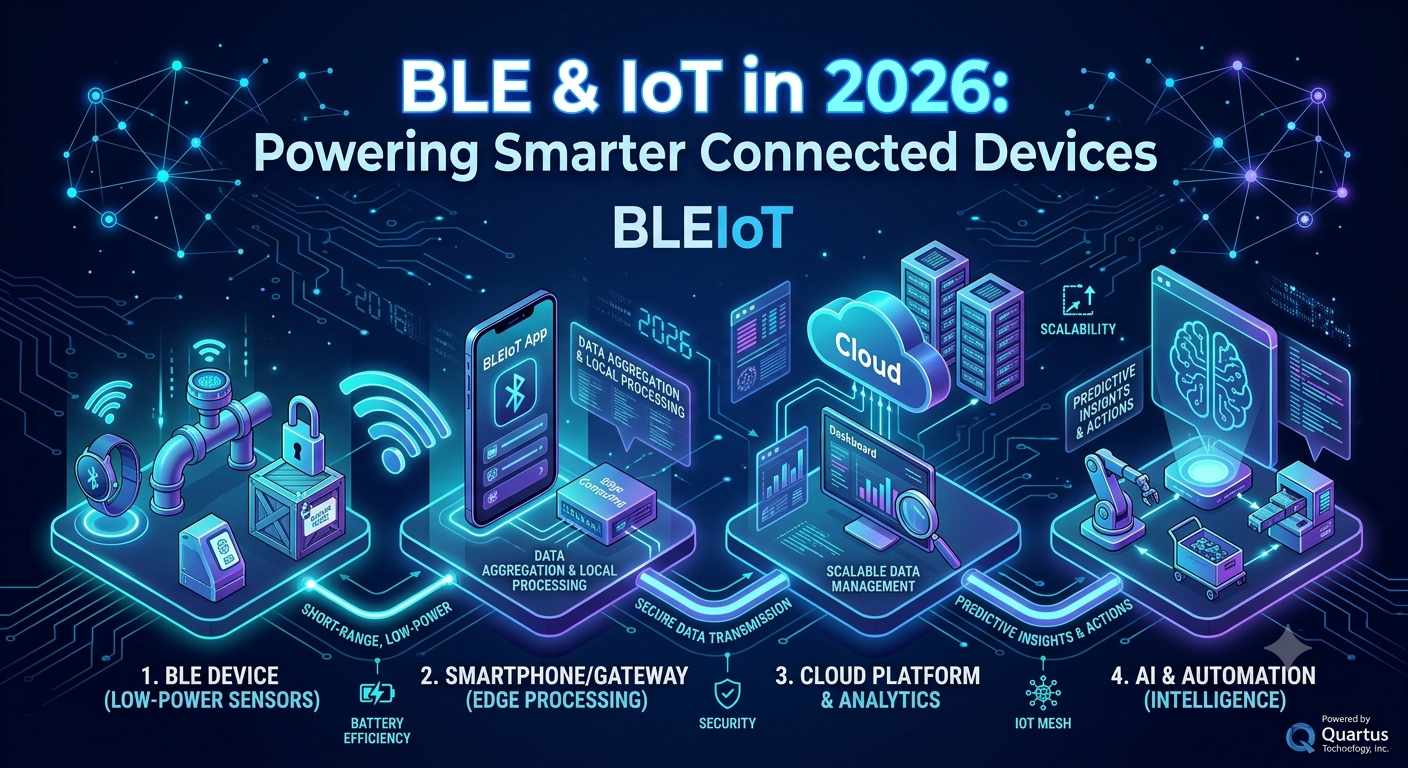
A typical BLE IoT architecture can look like:
BLE Device → Smartphone/Gateway → Cloud Platform → IoT Dashboard
Depending on the application, the smartphone or gateway can collect data from BLE devices and transmit it to a cloud or enterprise platform.
This creates a bridge between physical devices and digital applications.
Why BLE Is Important for IoT in 2026
IoT devices are often expected to operate for long periods while remaining small, affordable, and energy efficient.
BLE can be suitable for applications where devices need:
- Low-power communication
- Short-range connectivity
- Smartphone integration
- Sensor data transmission
- Device monitoring
- Proximity detection
- Wireless configuration
- Battery-powered operation
Instead of using high-power connectivity for every device, developers can use BLE where short-range, efficient communication makes sense.
BLE vs Traditional Bluetooth
Bluetooth technology has evolved significantly.
Classic Bluetooth is commonly associated with applications such as continuous audio streaming and other higher-bandwidth use cases.
BLE was designed with low-power communication in mind.
This makes BLE particularly attractive for:
- Sensors
- Wearables
- Beacons
- Fitness devices
- Medical devices
- Asset trackers
- Smart locks
- Industrial equipment
- Connected consumer products
The appropriate Bluetooth technology depends on the product’s communication requirements, data volume, range, power constraints, and architecture.
How BLE Works in an IoT Ecosystem
A BLE-enabled IoT solution generally contains several components.
1. BLE Device
The physical device collects or produces information.
Examples include:
- Temperature sensors
- Fitness trackers
- Smart locks
- Industrial sensors
- Medical devices
- Asset tags
2. BLE Communication
The device communicates wirelessly with a compatible smartphone, gateway, or other BLE-enabled system.
3. Mobile Application or Gateway
A mobile application or gateway can receive BLE data and perform processing or forwarding.
4. Cloud or Backend
The backend can store, process, and analyze device information.
5. Dashboard
Businesses can use web or mobile dashboards to monitor connected devices and their data.
This creates an end-to-end connected product ecosystem.
Key BLE IoT Use Cases
Healthcare and Medical Devices
BLE can connect health and wellness devices with mobile applications.
Potential applications include:
- Fitness monitoring
- Wearable devices
- Temperature monitoring
- Blood pressure devices
- Patient monitoring
- Rehabilitation equipment
For medical applications, security, reliability, regulatory requirements, and appropriate validation are critical.
Industrial IoT
Industrial environments contain large numbers of sensors and connected machines.
BLE can support applications such as:
- Equipment monitoring
- Sensor networks
- Asset tracking
- Maintenance systems
- Environmental monitoring
- Worker safety solutions
BLE can provide a convenient connectivity option for certain short-range industrial applications.
Smart Buildings
BLE can also contribute to smart-building ecosystems.
Applications can include:
- Smart access
- Occupancy monitoring
- Asset tracking
- Indoor positioning
- Environmental sensors
- Building automation
BLE-enabled devices can communicate with gateways and software platforms to create more connected environments.
Retail and Customer Experiences
Retail businesses can use BLE technology for proximity-based experiences and connected retail applications.
Potential use cases include:
- Indoor navigation
- Product discovery
- Asset tracking
- Proximity notifications
- Smart shelves
- Customer engagement
When BLE data is combined with analytics, businesses can gain additional insights into physical environments.
Asset Tracking
BLE tags can help organizations monitor the location or movement of assets within appropriate coverage areas.
Businesses can potentially track:
- Equipment
- Inventory
- Tools
- Medical assets
- Containers
- Warehouse items
The architecture should be selected based on required accuracy, range, battery life, environment, and cost.
BLE Beacons and IoT
BLE beacons are small wireless devices that periodically transmit signals that compatible devices can detect.
A beacon-based architecture can support:
Beacon → Mobile Device/Gateway → Application → Backend
This can be used for proximity detection, indoor experiences, asset monitoring, and location-aware applications.
The value of beacons increases when their data is connected to a broader IoT platform.
BLE Mesh and Connected Environments
For applications requiring communication across a larger physical environment, Bluetooth Mesh can provide a different architecture from traditional point-to-point BLE connections.
Mesh networking can allow compatible devices to communicate through a network of nodes.
Potential applications include:
- Smart lighting
- Building automation
- Industrial environments
- Sensor networks
- Commercial facilities
Whether BLE Mesh is appropriate depends on the application’s network topology, scalability, latency, power, and reliability requirements.
BLE + Edge Computing
IoT systems increasingly process information closer to where it is generated.
This is known as edge computing.
Instead of sending every piece of device data directly to the cloud, an edge gateway can perform certain processing locally.
For example:
BLE Sensor → Edge Gateway → Local Processing → Cloud
This can help reduce unnecessary data transmission and can be useful where quick local responses are required.
BLE + AI: The Next Step for Intelligent IoT
BLE provides connectivity, while AI can provide intelligence.
Combining the two creates opportunities for more advanced connected products.
For example:
BLE Sensor → Data Collection → AI Analysis → Insight → Automated Action
AI can potentially help with:
- Predictive maintenance
- Anomaly detection
- Pattern recognition
- Device behavior analysis
- Demand forecasting
- Personalization
The quality of the result depends heavily on the quality, relevance, and security of the underlying device data.
Security Considerations for BLE IoT
Connectivity should never come at the expense of security.
BLE IoT applications may need to address:
- Device authentication
- Secure pairing
- Encryption
- Access control
- Secure firmware updates
- API security
- Cloud security
- Data protection
- Device lifecycle management
Developers should consider security throughout the architecture rather than treating it as a final development step.
Challenges in BLE IoT Development
Although BLE provides many benefits, developing a reliable BLE IoT product can involve several technical challenges.
Device Compatibility
Different smartphones and operating systems can behave differently when interacting with BLE devices.
Power Management
Battery-powered devices need carefully optimized communication patterns.
Connectivity Reliability
Wireless environments can contain interference and connectivity limitations.
Scalability
A prototype that works with a few devices may require a different architecture when thousands or millions of devices are deployed.
Firmware Updates
Connected devices may need secure over-the-air firmware updates throughout their lifecycle.
Data Management
IoT systems can generate significant amounts of sensor data that need appropriate storage and processing strategies.
How to Build a BLE IoT Product
A successful BLE IoT project usually starts with a clearly defined product requirement.
Step 1: Define the Use Case
Determine exactly what the connected device needs to accomplish.
Step 2: Select the Hardware
Choose appropriate sensors, microcontrollers, BLE chipsets, and power systems.
Step 3: Design the BLE Architecture
Define services, characteristics, communication patterns, security, and device behavior.
Step 4: Build the Mobile or Gateway Layer
Develop the application or gateway responsible for communicating with the BLE device.
Step 5: Develop the IoT Backend
Create APIs, databases, device management, and cloud infrastructure.
Step 6: Add Analytics and Intelligence
Use analytics or AI where it provides measurable business value.
Step 7: Test the Complete Ecosystem
Testing should cover:
- Device connectivity
- Power consumption
- Different mobile devices
- Security
- Network conditions
- Firmware updates
- Scalability
- Real-world environments
Why Choose Custom BLE IoT Development?
Every connected product has different requirements.
A fitness device, industrial sensor, smart lock, and healthcare wearable cannot necessarily use the same architecture.
Custom BLE IoT development allows businesses to design solutions around their specific requirements.
A complete solution may combine:
- BLE hardware
- Firmware
- Mobile applications
- IoT gateways
- Cloud platforms
- APIs
- Web dashboards
- Data analytics
- AI
- Device management
This creates a complete connected-product ecosystem rather than simply adding Bluetooth connectivity to a device.
The Future of BLE IoT
The future of IoT is moving toward devices that are not only connected but also intelligent, automated, and context-aware.
BLE can continue to play an important role as an efficient communication technology for many short-range connected applications.
When BLE is combined with:
IoT + Edge Computing + AI + Cloud + Mobile Applications
businesses can create connected products capable of collecting data, communicating with software platforms, generating insights, and supporting automated workflows.
Final Thoughts
BLE and IoT are becoming increasingly interconnected as businesses develop smarter connected products.
From wearable devices and healthcare technology to industrial sensors, smart buildings, retail systems, and asset tracking, BLE can provide an efficient connectivity layer for many IoT applications.
The key is not simply choosing BLE technology. A successful product requires the right combination of hardware, firmware, BLE architecture, mobile development, cloud infrastructure, security, analytics, and user experience.
For businesses planning a connected product in 2026, a well-designed BLE IoT architecture can provide a strong foundation for building scalable and intelligent solutions.
Looking to develop a BLE-powered IoT solution?
BLEIoT can help businesses explore connected-device solutions combining Bluetooth Low Energy, IoT, mobile a