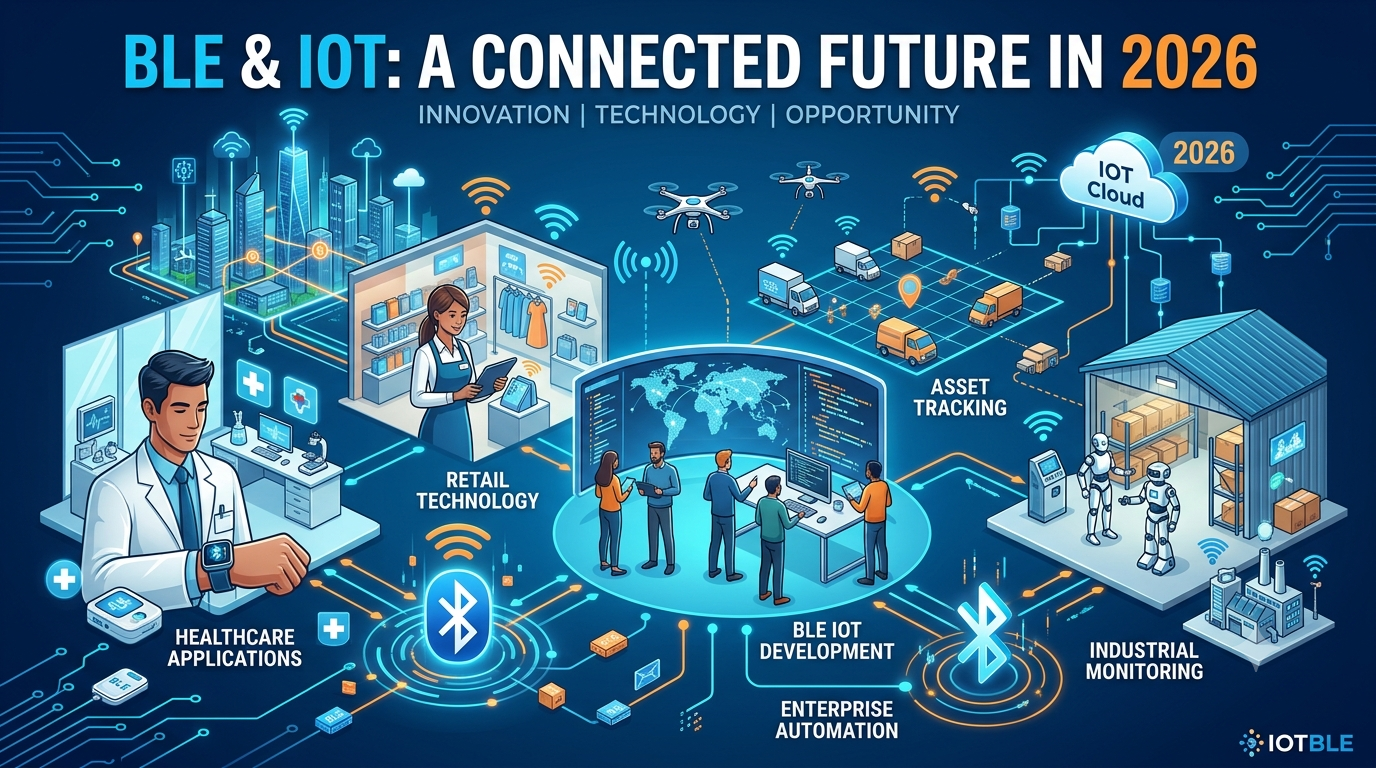
The Internet of Things is becoming a core part of digital transformation. Businesses are no longer connecting devices simply to collect data. They are building intelligent ecosystems where devices, mobile apps, cloud platforms, AI, and enterprise software work together in real time.
For IT companies and technology businesses, Bluetooth Low Energy (BLE) provides an efficient connectivity layer for building these connected solutions.
From smart devices and healthcare applications to asset tracking, industrial monitoring, retail technology, and enterprise automation, BLE IoT development is creating new opportunities for businesses in 2026.
What Is BLE IoT Development?
BLE IoT development combines Bluetooth Low Energy technology with IoT software and connected-device architecture.
A typical BLE IoT solution can connect:
BLE Device → Mobile App/Gateway → Cloud → API → Enterprise Software → Analytics/AI
This architecture allows physical devices to communicate with digital platforms and business applications.
A BLE IoT development project may include:
- BLE hardware integration
- Firmware development
- Mobile application development
- IoT gateway development
- Cloud integration
- API development
- Device management
- Real-time dashboards
- Data analytics
- AI integration
- Security implementation
Why BLE IoT Is Important for IT Companies in 2026
IT businesses are increasingly expected to build software that interacts with the physical world.
Traditional software works primarily with digital information. IoT adds another layer:
Physical Device → Real-World Data → Software → Intelligence → Action
BLE is useful in this environment because it supports low-power wireless communication between devices, smartphones, gateways, and other connected systems.
This makes BLE suitable for many enterprise and consumer applications.
Top BLE IoT Development Trends for 2026
1. AI + BLE IoT
Artificial intelligence is becoming one of the biggest trends in IoT development.
BLE devices can collect information from sensors, while AI can analyze the data and identify patterns.
For example:
BLE Sensors → Cloud Platform → AI Analysis → Business Decision
AI-powered BLE IoT systems can support:
- Predictive maintenance
- Anomaly detection
- Equipment monitoring
- Demand forecasting
- Energy optimization
- Automated alerts
- User behavior analysis
The future of IoT is moving from connected devices to intelligent connected systems.
2. Edge Computing for BLE Devices
Sending every sensor reading to the cloud is not always efficient.
Edge computing allows data to be processed closer to the device.
A modern architecture can look like:
BLE Device → Edge Gateway → Local Processing → Cloud
This can help reduce latency, bandwidth requirements, and unnecessary cloud processing.
For industrial and enterprise applications, edge computing can be particularly useful when real-time decisions are required.
3. BLE Asset Tracking
Asset tracking is a major business application for BLE technology.
BLE tags can be attached to:
- Equipment
- Tools
- Inventory
- Medical devices
- Warehouse products
- Vehicles
- Industrial assets
A complete asset tracking solution can combine BLE tags, gateways, mobile applications, cloud infrastructure, and analytics.
Businesses can then monitor asset movement and improve operational visibility.
4. BLE Indoor Positioning
GPS is not always practical inside buildings.
BLE technology can support indoor positioning and proximity-based applications.
Potential use cases include:
- Hospitals
- Warehouses
- Retail stores
- Airports
- Manufacturing facilities
- Corporate offices
- Smart buildings
BLE-based positioning can help businesses understand where devices, equipment, or users are located within an environment.
5. BLE Healthcare Solutions
Healthcare is another important area for BLE IoT development.
Connected healthcare devices can collect information and transmit it to mobile applications or healthcare platforms.
Examples include:
- Health monitoring devices
- Fitness trackers
- Medical sensors
- Rehabilitation equipment
- Wearable devices
- Patient monitoring solutions
For healthcare projects, developers need to consider security, privacy, reliability, regulatory requirements, and the intended use of the device.
6. Bluetooth Mesh for Enterprise IoT
Some IoT environments contain hundreds or thousands of connected devices.
Bluetooth Mesh can provide a networking approach for environments where many devices need to communicate.
Potential applications include:
- Smart lighting
- Smart buildings
- Industrial automation
- Commercial facilities
- Warehouse systems
IT companies can combine BLE Mesh with cloud platforms and enterprise dashboards to build scalable connected environments.
7. BLE Wearable Development
Wearables continue to be an important BLE application.
Smartwatches, fitness devices, healthcare wearables, and specialized enterprise wearables can use BLE to communicate with smartphones and other systems.
A wearable development project may require:
- BLE communication
- Sensor integration
- Firmware
- Android application
- iOS application
- Cloud APIs
- Data analytics
- Security
8. IoT Cloud Integration
A BLE device becomes much more powerful when it is connected to a cloud platform.
A cloud-based BLE IoT architecture can provide:
- Centralized device management
- Real-time data collection
- Remote monitoring
- User management
- Data storage
- Analytics
- API access
- Automated alerts
IT companies can integrate IoT data with existing enterprise applications such as CRM, ERP, inventory, and business intelligence platforms.
BLE IoT Architecture for IT Projects
A scalable BLE IoT platform can contain several layers.
Device Layer
Includes:
- BLE sensors
- BLE tags
- Wearables
- Embedded devices
- Smart equipment
Connectivity Layer
Handles communication through:
- Bluetooth Low Energy
- Bluetooth Mesh
- Wi-Fi
- Cellular
- Other gateway technologies
Gateway Layer
A gateway can collect information from multiple BLE devices and transfer it to the cloud.
Cloud Layer
The cloud platform manages:
- Device data
- APIs
- Authentication
- Databases
- Device management
- Analytics
Application Layer
Users can interact with the system through:
- Web dashboards
- Mobile applications
- Enterprise applications
- Admin portals
Intelligence Layer
AI and analytics can transform raw device information into useful insights.
Key Features of a BLE IoT Platform
When developing a BLE IoT solution, IT businesses should consider features such as:
- Device discovery
- Secure BLE pairing
- Device authentication
- Real-time data transmission
- Remote device monitoring
- Firmware updates
- Device provisioning
- User management
- Cloud synchronization
- API integration
- Analytics dashboards
- Automated notifications
- Multi-device management
- Role-based access
BLE IoT Security
Security should be included throughout the development lifecycle.
Important areas include:
- Secure pairing
- Encryption
- Authentication
- Device identity
- Secure APIs
- Cloud security
- Access control
- Firmware security
- Secure OTA updates
- Data protection
A connected device can become a potential entry point into a larger technology ecosystem, making security an essential part of BLE IoT architecture.
How IT Companies Can Build a BLE IoT Product
Step 1: Define the Use Case
Start by identifying the business problem.
For example:
Problem: Equipment is difficult to track.
Solution: BLE asset tags + gateways + cloud dashboard.
Step 2: Select Hardware
Choose the appropriate BLE chipset, sensors, battery, antenna, and device components.
Step 3: Develop Firmware
Firmware controls device communication, sensors, power management, data collection, and security.
Step 4: Build Mobile Applications
Android and iOS applications can be used for:
- Device setup
- Pairing
- Configuration
- Monitoring
- Data visualization
Step 5: Develop Cloud Infrastructure
Build APIs, databases, authentication, device management, and data processing.
Step 6: Add AI and Analytics
Use collected data to identify patterns, detect anomalies, and automate business processes.
Step 7: Integrate Enterprise Systems
Connect the IoT platform with existing:
- ERP systems
- CRM platforms
- Inventory software
- Business intelligence tools
- Custom enterprise applications
Step 8: Test and Scale
Testing should cover:
- BLE connectivity
- Battery consumption
- Range
- Device reliability
- Security
- Mobile compatibility
- Cloud performance
- Large-scale device deployments
Industries That Can Benefit From BLE IoT Development
Manufacturing
Monitor machines, equipment, environmental conditions, and production processes.
Healthcare
Connect wearable and monitoring devices.
Retail
Build proximity experiences, asset tracking, and smart retail applications.
Logistics
Track equipment, inventory, and assets.
Smart Buildings
Monitor lighting, occupancy, temperature, and connected systems.
Automotive
Build connected vehicle accessories and proximity solutions.
Fitness
Connect wearable devices and fitness sensors.
Enterprise
Integrate physical devices with business software and analytics platforms.
Why Choose Custom BLE IoT Development?
Off-the-shelf IoT platforms may not always match the requirements of a specific product.
Custom BLE IoT development allows businesses to control:
- Device functionality
- Firmware
- Mobile applications
- Cloud architecture
- APIs
- Security
- User experience
- Analytics
- Enterprise integrations
This can provide greater flexibility when building a long-term IoT product.
The Future of BLE IoT Development
The future of IoT will be increasingly connected, intelligent, and automated.
BLE will continue to play an important role in connecting low-power devices, while AI, edge computing, cloud platforms, advanced analytics, and enterprise software will make those devices more useful.
The next generation of IoT solutions will not simply answer:
“Is the device connected?”
They will answer:
“What is happening, why is it happening, and what should happen next?”
That is where the combination of BLE + IoT + AI becomes particularly powerful.
Build Your BLE IoT Solution With BLEIoT
Developing a successful IoT product requires expertise across hardware connectivity, BLE communication, firmware, mobile applications, cloud infrastructure, APIs, security, and analytics.
BLEIoT can help businesses explore and develop connected solutions around their specific product and technology requirements.
Whether you are building BLE wearables, smart sensors, asset tracking systems, healthcare devices, industrial IoT solutions, Bluetooth Mesh networks, or connected enterprise products, a scalable BLE architecture can provide the foundation for future growth.
SEO Keywords
- BLE IoT development
- BLE IoT development company
- Bluetooth IoT development
- BLE development company
- BLE product development
- Bluetooth Low Energy development
- IoT product development
- BLE software development
- BLE firmware development
- BLE mobile app development
- BLE gateway development
- BLE asset tracking
- BLE indoor positioning
- Bluetooth Mesh development
- industrial IoT development
- BLE wearable development
- IoT solutions for enterprises
- AI IoT development
- edge IoT development
- connected device development
- IoT development trends 2026
- BLE IoT trends 2026