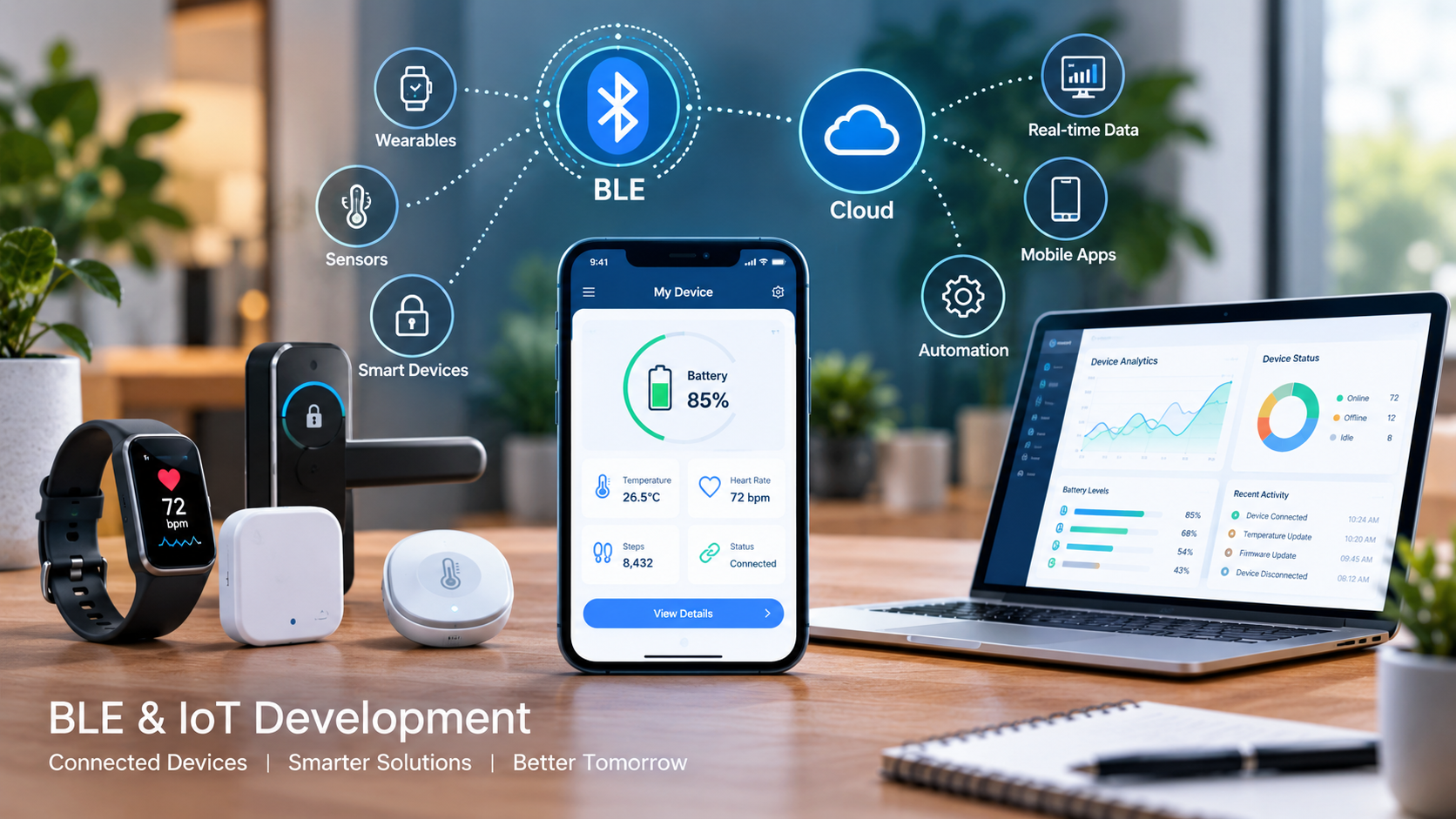
Connected technology is moving from simple device communication to intelligent, data-driven ecosystems.
Today, businesses are building wearables, smart sensors, medical devices, fitness trackers, smart locks, EV chargers, industrial systems, and connected consumer products that need reliable communication between hardware, mobile applications, cloud platforms, and users.
This is where Bluetooth Low Energy (BLE) and IoT development become important.
A well-designed BLE IoT solution can connect devices efficiently while collecting data, enabling automation, supporting remote monitoring, and creating better user experiences.
What Is BLE IoT Development?
BLE IoT development combines Bluetooth Low Energy technology with Internet of Things systems to allow connected devices to communicate with mobile apps, gateways, cloud platforms, and other systems.
A typical architecture can look like:
BLE Device → Mobile App/Gateway → Cloud Platform → Dashboard → Business Insights
BLE is particularly useful for connected products because it is designed for low-power wireless communication.
For businesses, this can open the door to applications such as:
- Wearable technology
- Smart sensors
- Healthcare devices
- Fitness trackers
- Industrial monitoring
- Asset tracking
- Smart locks
- EV charging systems
- Location-based applications
- Connected consumer products
Why Bluetooth Low Energy Matters for IoT
Traditional connectivity isn’t always appropriate for battery-powered devices.
BLE is designed for applications where devices need to communicate wirelessly while managing power consumption carefully.
A BLE solution can support different communication models depending on the product requirements.
For example:
Peripheral device → Smartphone → Cloud
or
Multiple BLE sensors → Gateway → IoT platform
This makes BLE useful for products that need reliable short-range communication and integration with mobile or cloud applications.
Key Components of a Modern BLE IoT Solution
1. BLE Device Development
The hardware is the foundation of a connected product.
BLE device development involves designing communication behavior so that the device can advertise, connect, exchange data, and work reliably with the intended application.
The right architecture depends on factors such as:
- Power requirements
- Communication range
- Data volume
- Connection frequency
- Hardware capabilities
- Security requirements
2. Custom GATT Services
The Generic Attribute Profile (GATT) defines how BLE devices organize and exchange information.
Custom GATT services can be created around the specific data model of a product.
For example, a connected health device might expose characteristics for:
- Device status
- Sensor readings
- Battery information
- Configuration
- Device commands
A well-planned GATT architecture helps mobile applications and embedded systems communicate consistently.
3. BLE Mobile App Development
A connected device often needs a mobile application to configure, monitor, or control it.
Native BLE development can involve:
- iOS CoreBluetooth
- Android Bluetooth APIs
The application may handle:
- Device discovery
- Pairing
- Connection management
- Data transfer
- Device configuration
- Notifications
- Firmware updates
- User authentication
Mobile BLE development also needs to account for platform-specific behavior, permissions, background operation, and different device environments.
4. Secure Device Provisioning and Pairing
The first interaction between a device and a user can have a major impact on the overall product experience.
A good provisioning process should make it easy for users to:
- Discover the device
- Establish a secure connection
- Associate the device with an account
- Configure settings
- Start using the product
Security should be considered throughout this process rather than added later.
5. OTA Firmware Updates
Connected products don’t always remain unchanged after launch.
Manufacturers may need to fix bugs, improve performance, add capabilities, or address security issues.
Over-the-air (OTA) firmware updates allow compatible devices to receive firmware updates without requiring physical access.
A robust OTA system should consider:
- Secure firmware delivery
- Update validation
- Connection interruptions
- Recovery mechanisms
- Version management
- Device compatibility
This becomes particularly valuable when hundreds or thousands of devices are already deployed.
6. IoT Cloud Integration
BLE handles local wireless communication, but many IoT products also need a cloud layer.
Cloud integration can allow businesses to:
- Collect device data
- Store information
- Monitor connected devices
- Analyze usage
- Manage users
- Trigger automated workflows
- Build real-time dashboards
BLE IoT systems can connect with platforms such as AWS IoT, Azure IoT, and Google Cloud, depending on project requirements.
7. Real-Time Data Monitoring
IoT becomes significantly more valuable when device data can be transformed into useful information.
A monitoring dashboard can display:
- Device status
- Sensor readings
- Battery levels
- Alerts
- Usage patterns
- Connectivity information
- Historical data
Businesses can use this information to identify problems, monitor operations, and improve connected products.
BLE Beacons and Location-Based Experiences
BLE beacon technologies such as iBeacon and Eddystone can support proximity-based applications.
Possible use cases include:
- Indoor positioning
- Proximity notifications
- Location-aware experiences
- Retail engagement
- Asset identification
- Navigation systems
The exact implementation depends on the environment, hardware, mobile platform, and accuracy requirements.
BLE IoT Development for Different Industries
Healthcare
BLE-enabled medical and wellness devices can collect information from sensors and transmit it to mobile or cloud applications.
Examples include:
- Patient monitoring
- Wearable devices
- Fitness sensors
- Medical equipment connectivity
Healthcare products may also require additional security, testing, and regulatory considerations.
Fitness and Wearables
Fitness trackers and wearable products can use BLE to communicate with smartphones and synchronize information.
Potential data can include:
- Activity
- Heart rate
- Workout information
- Device status
- Performance metrics
Industrial IoT
Industrial sensors can use BLE and IoT technologies to monitor equipment and operational conditions.
Connected systems can help businesses collect information from distributed devices and make it available through centralized dashboards.
Smart Home
BLE can also support smart locks, sensors, controllers, and other connected home products.
Mobile applications can provide users with configuration, monitoring, and control capabilities.
EV Charging
Connected EV charging systems can combine BLE communication, mobile applications, cloud services, and monitoring platforms to create a more connected charging experience.
Choosing the Right BLE IoT Development Partner
Building a connected product requires more than mobile app development.
A development team may need expertise across:
- BLE protocol implementation
- Embedded firmware
- Custom GATT services
- Native iOS development
- Native Android development
- Device provisioning
- OTA firmware updates
- Cloud infrastructure
- IoT APIs
- Security
- Hardware testing
- Production support
This end-to-end approach helps ensure that the device, application, backend, and cloud infrastructure work together as one system.
Why BLEIoT for Connected Product Development?
BLEIoT, powered by Quartus Technology, focuses on BLE Bluetooth, IoT, and AI-powered mobile application development. Its services include BLE device development, IoT system integration, smart sensor networks, gateway and cloud connectivity, and real-time data monitoring.
The platform also highlights experience with BLE peripheral and central implementations, custom GATT services, device provisioning, OTA updates, beacon technologies, embedded firmware integration, and iOS and Android Bluetooth APIs.
For companies developing a new connected product, this combination can help bring together the different technical layers required for a complete BLE IoT ecosystem.
Frequently Asked Questions
What is BLE in IoT?
BLE, or Bluetooth Low Energy, is a wireless communication technology commonly used to connect low-power devices with smartphones, gateways, sensors, and other connected systems.
What is GATT in BLE?
GATT, or Generic Attribute Profile, defines how BLE devices organize and exchange data through services and characteristics.
Can BLE devices connect to the cloud?
Yes. BLE devices can communicate with a smartphone or gateway, which can then transfer information to a cloud platform.
What is an OTA firmware update?
OTA means over-the-air. It allows compatible connected devices to receive firmware updates remotely rather than requiring physical access.
Can BLE IoT applications work with both iOS and Android?
Yes. BLE applications can be developed for both platforms using technologies such as Apple’s CoreBluetooth framework and Android Bluetooth APIs.
What products can use BLE IoT technology?
BLE IoT can be used in wearables, medical devices, fitness trackers, smart locks, industrial sensors, EV chargers, smart devices, and many other connected products.
Final Thoughts
The future of connected products depends on more than simply putting Bluetooth into a device.
Successful BLE IoT development requires coordination between hardware, firmware, BLE communication, mobile applications, cloud infrastructure, security, and data.
When these components are designed as one connected ecosystem, businesses can build products that are easier to monitor, update, scale, and improve.
Whether you’re developing a BLE wearable, IoT sensor, smart device, medical product, industrial system, or connected mobile application, the right architecture can turn device connectivity into a complete digital product.
Smart connectivity starts with the right technology—and the right development strategy.