Bluetooth Low Energy sounds simple.
A device connects.
Data gets transferred.
The sensor sends information.
The application displays it.
Done.
Except…
The device doesn’t connect.
Welcome to the world of BLE IoT development, where a tiny Bluetooth connection can sometimes create a problem large enough to require coffee, debugging tools, logs, and another cup of coffee.
BLE and IoT technologies are helping businesses build connected products for healthcare, fitness, smart homes, industrial monitoring, retail, logistics, and many other applications.
But developers working with connected devices know that technology can have a sense of humor.
Here are 10 situations every BLE IoT developer will recognize.
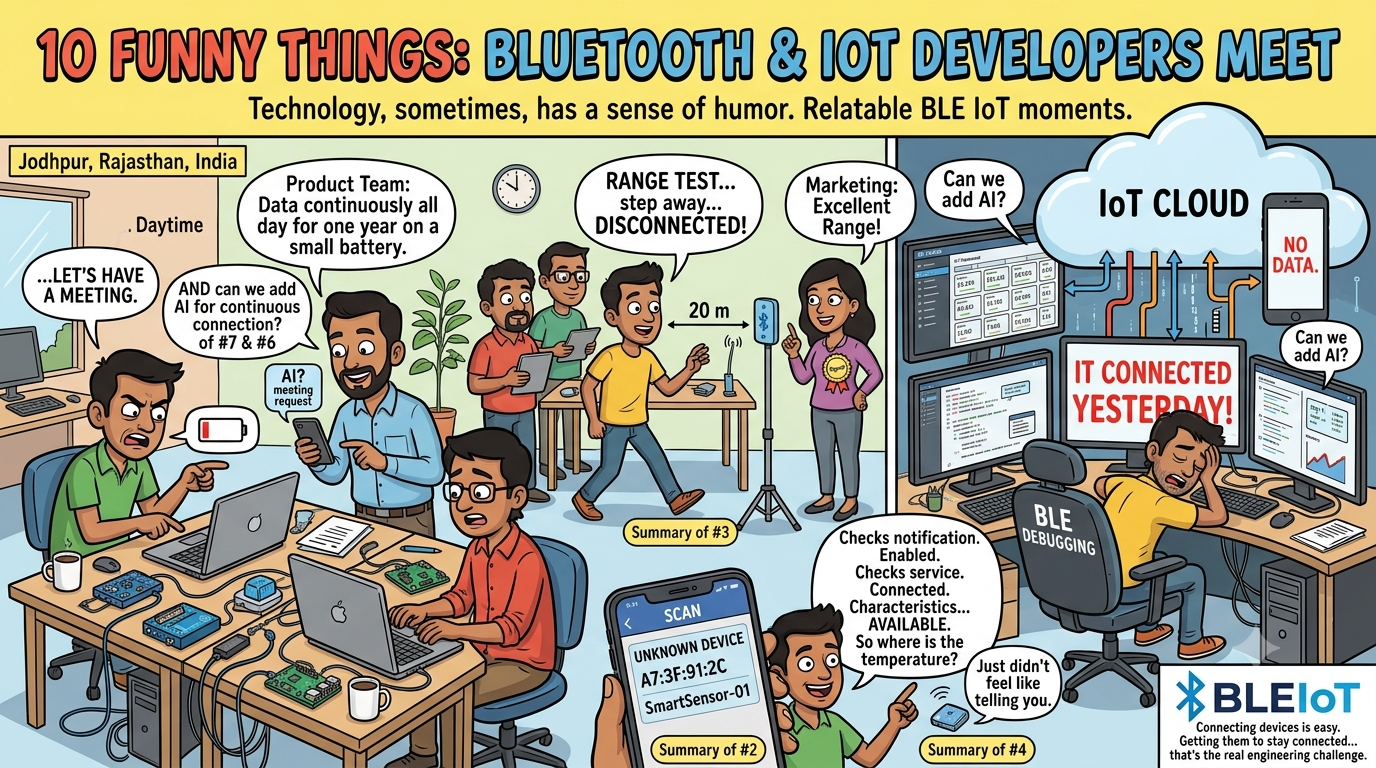
1. “It Connected Yesterday”
Developer:
“The BLE device connected perfectly yesterday.”
Today:
Nothing.
Restart phone.
Nothing.
Restart device.
Nothing.
Restart application.
Nothing.
Turn Bluetooth off.
Turn Bluetooth on.
Still nothing.
Developer:
“What changed?”
Bluetooth:
“I don’t want to talk about it.”
2. The Device Name Mystery
You scan for nearby BLE devices.
Expected:
SmartSensor-01
Actual:
Unknown Device
Another:
Unknown Device
Another:
A7:3F:91:2C
Developer:
“Which one is ours?”
The device:
“Good luck.”
Proper device discovery and identification become especially important when multiple BLE devices are operating in the same environment.
3. The Range Test
Marketing:
“Our BLE device has excellent range.”
Developer walks 5 meters away.
Works.
10 meters.
Works.
15 meters.
Works.
20 meters.
Developer takes another step.
Disconnected.
Developer:
“Okay, 20 meters is apparently a very emotional boundary.”
BLE performance can depend on factors such as device hardware, antenna design, environment, interference, transmission settings, and implementation.
4. “The Sensor Sent Nothing”
The IoT sensor is supposed to send temperature data.
Application:
No data.
Developer checks the app.
Fine.
Checks the BLE connection.
Connected.
Checks the service.
Available.
Checks the characteristic.
Available.
Checks notifications.
Enabled.
Developer:
“So where is the temperature?”
Sensor:
“It’s 27.4°C. I just didn’t feel like telling you.”
This is why BLE debugging often requires checking the entire communication chain rather than looking at only the application.
5. The Famous Pairing Question
User:
“Why do I have to pair it?”
Developer:
“Actually, BLE connections don’t always work the same way as classic Bluetooth pairing…”
User:
“Can you just make it connect?”
Developer:
“Yes.”
User:
“Without doing anything?”
Developer:
“…I’ll try.”
Understanding the difference between Bluetooth pairing, bonding, discovery, connection, services, and characteristics is an important part of BLE application development.
6. The Battery Conversation
Product team:
“We need the device to run for one year on a small battery.”
Developer:
“Okay.”
Product team:
“And it should send data continuously.”
Developer:
“Okay…”
Product team:
“And maintain a connection all day.”
Developer:
“Let’s have a meeting.”
BLE is designed for low-power communication, but actual battery life depends on the complete device architecture, communication pattern, hardware, firmware, sensors, and power-management strategy.
7. The IoT Dashboard
Management:
“We need real-time IoT monitoring.”
Developer builds dashboard.
Dashboard displays:
Temperature.
Humidity.
Battery level.
Signal strength.
Device status.
Location.
Alerts.
Analytics.
Reports.
Management:
“Excellent.”
Five minutes later:
“Can we add AI?”
Developer:
“Of course.”
That’s how a temperature sensor becomes an artificial-intelligence project.
8. When 50 Devices Become 500
Testing:
5 BLE devices.
Everything works.
Then:
50 devices.
Things become interesting.
Then:
500 devices.
Developer:
“We need a bigger test environment.”
Scaling BLE IoT solutions requires thinking about device management, connectivity, data processing, cloud architecture, security, and monitoring—not just whether one device can connect successfully.
9. “It’s Just a Sensor”
Client:
“It’s just a small IoT sensor.”
Developer:
“What’s it supposed to do?”
Client:
“Measure temperature.”
Developer:
“Okay.”
Client:
“And humidity.”
“Okay.”
“Send data through BLE.”
“Okay.”
“Store it in the cloud.”
“Okay.”
“Show it in a mobile app.”
“Okay.”
“Send alerts.”
“Okay.”
“Work for two years on battery.”
Developer:
“Ah. Just a sensor.”
10. The Ultimate BLE Developer Experience
After hours of debugging:
Developer changes one line of code.
Builds application.
Runs it.
Scans for device.
Device appears.
Connects.
Services discovered.
Characteristic found.
Notifications enabled.
Data arrives.
Developer:
“YES!”
Then the device disconnects.
Developer:
“…Never mind.”
And the debugging cycle begins again.
What Makes a Good BLE IoT Solution?
Behind the funny moments, successful BLE IoT development requires careful planning.
A reliable solution may involve:
- Bluetooth Low Energy communication
- BLE service and characteristic design
- Mobile application integration
- Sensor connectivity
- Device firmware
- IoT cloud platforms
- Real-time data processing
- Device management
- Authentication and security
- Battery optimization
- Connectivity monitoring
- Data analytics
- Scalable backend architecture
The best architecture depends on the product, hardware, communication requirements, user environment, and business goals.
Final Thoughts
BLE makes it possible for devices to communicate efficiently while using relatively little power.
IoT makes it possible to collect that device data and turn it into useful information.
Together, BLE and IoT can create powerful connected products.
But every developer knows there is one universal rule:
If everything worked on the first attempt, check the code again. Something is probably wrong.
At BLEIoT, the focus is on helping businesses build connected products and applications using BLE, IoT, mobile technologies, cloud systems, and intelligent data solutions.
Because connecting two devices is easy.
Getting them to stay connected when the customer is watching?
That’s the real engineering challenge.