The Internet of Things is changing how businesses connect physical devices with software, cloud platforms, and real-time data.
From industrial sensors and healthcare devices to smart buildings, asset tracking, wearables, and connected products, businesses need reliable wireless technologies that can operate efficiently while consuming minimal power.
Bluetooth Low Energy (BLE) has become an important connectivity technology for these applications.
In 2026, BLE IoT development is moving beyond basic device connectivity. Businesses are combining BLE with mobile applications, gateways, cloud platforms, edge computing, analytics, automation, and AI to create complete connected ecosystems.
BLE is particularly useful for low-power IoT applications where devices need short-range wireless communication and long battery life. Recent research and industry developments also continue to explore BLE for edge computing, asset tracking, smart buildings, and other low-power IoT applications.
What Is BLE IoT?
BLE IoT refers to the use of Bluetooth Low Energy technology to connect sensors, devices, machines, and physical products with software applications and IoT platforms.
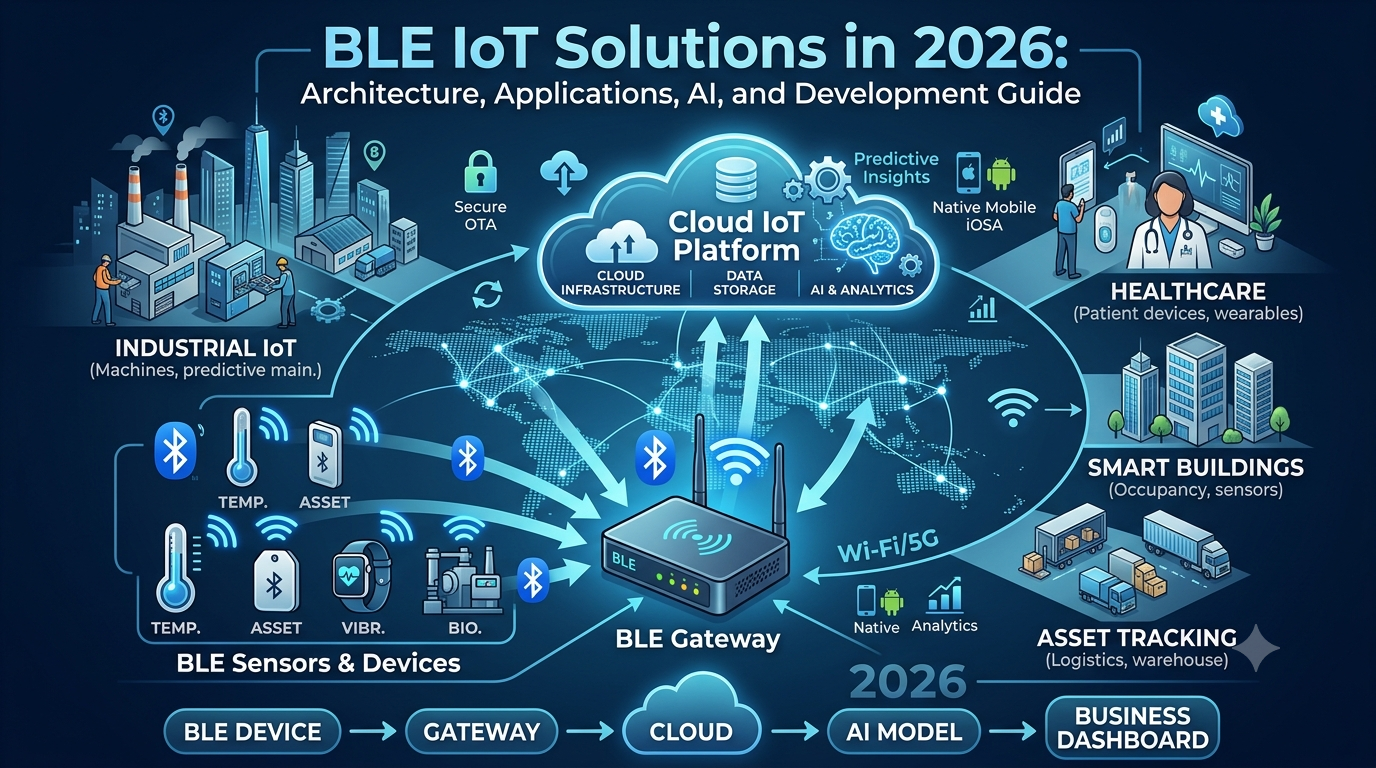
A typical BLE IoT ecosystem can look like:
BLE Device → Mobile App / Gateway → Cloud Platform → Data Processing → Analytics → Business Application
A BLE device can collect information such as:
- Temperature
- Humidity
- Motion
- Pressure
- Battery status
- Proximity
- Equipment status
- Environmental conditions
- Sensor measurements
That information can then be processed locally or transmitted to an IoT platform for storage, monitoring, automation, or analysis.
Why Businesses Are Using BLE for IoT
BLE provides several characteristics that make it useful for connected products.
Low Power Consumption
Battery-powered IoT products often need to operate for long periods without frequent charging or battery replacement.
BLE is designed for low-power wireless communication, making it suitable for many sensor and wearable applications.
Smartphone Compatibility
Modern smartphones provide BLE capabilities, allowing mobile applications to communicate directly with compatible devices.
This can eliminate the need for a dedicated gateway for certain applications.
Flexible Connectivity
BLE can be used in architectures involving:
- Smartphones
- Tablets
- Gateways
- Embedded controllers
- Edge devices
- Cloud platforms
Cost-Effective Connected Products
BLE can help businesses create compact connected products without requiring every device to have its own cellular or Wi-Fi connection.
BLE IoT Architecture
A BLE IoT solution generally consists of several layers.
1. Connected Hardware
The physical device contains a BLE-capable chipset and may include sensors or actuators.
For example:
BLE Sensor → Temperature Data
BLE Tracker → Location/Proximity Data
BLE Device → Equipment Status
2. BLE Communication Layer
The BLE layer handles communication between the connected device and another BLE-capable system.
This can involve:
- Advertising
- Scanning
- Pairing
- Connection management
- GATT services
- Characteristics
- Notifications
- Device commands
3. Mobile or Gateway Layer
A smartphone, tablet, or dedicated gateway can receive information from BLE devices.
The gateway can then transfer data through:
- Wi-Fi
- Ethernet
- Cellular
- Other network connections
4. Cloud and IoT Platform
The cloud layer can provide:
- Device management
- Data storage
- Authentication
- APIs
- Analytics
- Alerts
- Reporting
- Remote monitoring
5. Business Dashboard
The final layer turns device data into useful business information.
For example:
BLE Sensor → Gateway → Cloud → Analytics → Maintenance Alert
This allows a business to move from simple device connectivity to automated decision-making.
Top BLE IoT Applications in 2026
1. Industrial IoT
Industrial businesses can use BLE sensors to monitor machines, equipment, and environmental conditions.
Applications include:
- Equipment monitoring
- Temperature monitoring
- Machine status
- Predictive maintenance
- Asset tracking
- Environmental monitoring
- Worker safety
For example, a BLE sensor attached to equipment can periodically report temperature or vibration information to an IoT gateway.
The backend can analyze that information and trigger an alert when a predefined threshold is reached.
2. Healthcare and Medical Devices
BLE is useful for connected healthcare products where low-power wireless communication is important.
Potential applications include:
- Patient monitoring
- Medical sensors
- Fitness devices
- Healthcare wearables
- Digital health products
- Connected medical equipment
Healthcare applications require additional attention to security, privacy, reliability, and applicable regulatory requirements.
3. Smart Buildings
BLE and IoT can be combined to create connected building environments.
Applications can include:
- Occupancy monitoring
- Smart lighting
- Environmental sensing
- Indoor navigation
- Access systems
- Room management
- Asset tracking
Recent research into low-power IoT technologies identifies BLE as one of the communication technologies relevant to smart-building environments.
4. Asset Tracking
BLE tags and sensors can provide businesses with visibility into physical assets.
Potential applications include:
- Warehouse equipment
- Hospital equipment
- Industrial tools
- Retail assets
- Logistics
- Inventory monitoring
A gateway can detect nearby BLE devices and send information to a central platform.
This can help businesses understand whether assets are present, moving, or outside expected areas.
5. Wearable Technology
Wearables are one of the most established BLE use cases.
Examples include:
- Fitness trackers
- Smartwatches
- Health devices
- Industrial wearables
- Safety equipment
- Connected accessories
A typical architecture is:
Wearable → BLE → Smartphone → Cloud
The mobile application can display data, configure the device, synchronize information, and send selected data to a cloud platform.
6. Smart Retail
BLE IoT can also support retail technology.
Potential applications include:
- Smart shelves
- Asset tracking
- Proximity experiences
- Store analytics
- Inventory monitoring
- Electronic shelf labels
Bluetooth industry materials continue to identify asset tracking, retail, and low-power connected-device networks as areas of development for Bluetooth technology.
7. Automotive and Connected Equipment
BLE can be used for short-range communication between mobile devices and connected equipment.
Possible applications include:
- Vehicle accessories
- Equipment configuration
- Diagnostic devices
- Smart controls
- Digital keys
- Connected sensors
The appropriate wireless technology depends on the required range, bandwidth, power consumption, security model, and application architecture.
BLE IoT and AI
One of the biggest opportunities in connected-device development is combining BLE IoT with artificial intelligence.
BLE provides the connectivity layer.
IoT infrastructure collects and manages the data.
AI can then analyze that data and generate insights.
A simplified architecture is:
BLE Sensors → IoT Platform → Data Processing → AI Model → Business Insight → Automated Action
AI-Powered Predictive Maintenance
Industrial sensors can collect information about equipment conditions.
AI models can analyze historical and real-time data to identify unusual patterns.
For example:
Sensor Data → AI Analysis → Anomaly Detected → Maintenance Alert
This can help businesses investigate potential equipment problems before they become larger operational issues.
AI-Based Anomaly Detection
AI can analyze connected-device data and identify behavior that differs from normal patterns.
Possible applications include:
- Equipment monitoring
- Energy monitoring
- Environmental monitoring
- Security systems
- Industrial IoT
- Smart buildings
Intelligent IoT Dashboards
Instead of displaying hundreds of raw sensor readings, an AI-enabled dashboard can summarize important information.
For example:
“Three devices reported abnormal temperature readings during the last hour.”
This makes large IoT deployments easier for business teams to monitor.
BLE Gateway Development
A BLE gateway can act as a bridge between local BLE devices and internet-connected infrastructure.
A typical gateway architecture is:
Multiple BLE Devices → BLE Gateway → Internet → Cloud Platform
The gateway can:
- Scan BLE devices
- Collect sensor data
- Filter information
- Authenticate devices
- Process data locally
- Send data to the cloud
- Receive commands
- Support remote management
Gateways become particularly useful when hundreds or thousands of BLE devices need to communicate with a centralized IoT platform.
BLE and Edge Computing
Not every IoT operation needs to send every piece of data to the cloud.
Edge computing allows some processing to happen closer to the physical device.
For example:
BLE Sensor → Edge Gateway → Local Analysis → Cloud
This architecture can reduce unnecessary data transmission and support faster local responses.
Research published in 2026 has specifically explored Bluetooth 5 in low-power IoT systems using edge-computing architectures.
Custom GATT Services
For custom BLE products, developers may create GATT services and characteristics around the product’s data model.
For example:
Custom BLE Service
- Temperature Characteristic
- Battery Characteristic
- Device Status Characteristic
- Configuration Characteristic
- Command Characteristic
This gives the mobile application or gateway a structured way to communicate with the hardware.
BLE Device Provisioning
Device onboarding is an important part of an IoT product.
A typical workflow can be:
New Device → Discovery → Authentication → Pairing → Configuration → Cloud Registration
Secure provisioning can associate a physical device with a particular:
- Customer
- User
- Location
- Account
- IoT deployment
This becomes increasingly important when businesses deploy large numbers of connected devices.
OTA Firmware Updates
Connected products often require firmware updates after they are deployed.
Over-the-Air (OTA) technology allows businesses to update device firmware without physically accessing every device.
OTA updates can be used for:
- Bug fixes
- Security updates
- Performance improvements
- New features
- Device configuration
A production OTA system should consider firmware authentication, integrity verification, interrupted downloads, device compatibility, and recovery or rollback mechanisms.
BLE IoT Security
Security needs to be considered across the complete connected ecosystem.
Device Security
Connected hardware should implement appropriate security mechanisms for its use case.
BLE Security
Depending on the application, developers may need to consider:
- Secure pairing
- Authentication
- Encryption
- Key management
- Device authorization
API Security
Cloud APIs should use appropriate authentication and authorization controls.
Cloud Security
IoT infrastructure should also include appropriate:
- Identity management
- Access controls
- Monitoring
- Logging
- Data protection
- Backup strategies
Security should be part of the architecture from the beginning rather than added after development.
BLE IoT Development Process
Developing a connected product often requires hardware, firmware, mobile, cloud, and backend expertise.
Step 1: Define the Product Requirements
Determine:
- What device needs to be connected?
- What data should it collect?
- How frequently should data be transmitted?
- What battery life is required?
- Is a mobile app required?
- Is a gateway required?
- What cloud platform will be used?
Step 2: Select Hardware
Hardware selection may involve:
- BLE chipset
- Microcontroller
- Sensors
- Antenna
- Battery
- Gateway hardware
Step 3: Design BLE Communication
The development team defines:
- GATT services
- Characteristics
- Data formats
- Commands
- Notifications
- Pairing
- Connection behavior
Step 4: Develop Firmware
Firmware controls the device’s core behavior.
It can manage:
- Sensors
- BLE communication
- Power management
- Data processing
- Device commands
- Firmware updates
Step 5: Develop the Mobile Application
The mobile application may provide:
- Device discovery
- Pairing
- Configuration
- Data visualization
- Device control
- Cloud synchronization
Native BLE APIs such as iOS CoreBluetooth and Android Bluetooth APIs can be used for mobile connectivity. BLEIoT currently lists native iOS and Android BLE development among its capabilities.
Step 6: Build the Cloud Platform
The backend can provide:
- Device registration
- User management
- Data storage
- Device monitoring
- APIs
- Notifications
- Analytics
- Reporting
Step 7: Test the Complete System
Testing should include:
- BLE connectivity
- Device range
- Battery consumption
- Firmware reliability
- Mobile compatibility
- Gateway communication
- Cloud synchronization
- Security
- OTA updates
- Real-world hardware testing
BLE vs Wi-Fi for IoT
The right connectivity technology depends on the application.
| Requirement | BLE | Wi-Fi |
|---|---|---|
| Low power | Strong use case | Generally higher power |
| Smartphone connectivity | Excellent | Excellent |
| Short-range sensors | Well suited | Possible |
| Direct internet connectivity | Usually requires gateway/phone | Native |
| High data throughput | Limited compared with Wi-Fi | Strong |
| Battery-powered devices | Often suitable | Can be challenging |
| IoT sensors | Common use case | Common use case |
BLE and Wi-Fi do not necessarily have to compete.
Many real-world IoT architectures use them together:
BLE Device → Wi-Fi Gateway → Cloud
Why Businesses Need a BLE IoT Development Partner
A complete connected product can involve:
Hardware + Firmware + BLE + Mobile + Cloud + IoT + Security + Analytics
Choosing a development partner with experience across these layers can simplify the development process.
BLEIoT’s current service offering includes BLE device development, IoT system integration, smart sensor networks, gateway and cloud connectivity, custom GATT services, device provisioning, OTA firmware updates, beacon technologies, embedded firmware integration, and native iOS and Android BLE development.
What a BLE IoT Development Company Can Build
A development team can help businesses create:
- BLE sensors
- IoT gateways
- Wearable applications
- Healthcare devices
- Industrial monitoring systems
- Asset tracking solutions
- Smart-building systems
- Connected consumer products
- BLE mobile applications
- Cloud-connected devices
- AI-powered IoT platforms
Frequently Asked Questions
What is BLE IoT development?
BLE IoT development involves creating connected systems that use Bluetooth Low Energy to communicate between sensors, devices, mobile applications, gateways, and IoT platforms.
Is BLE good for IoT?
BLE can be well suited to IoT applications that require low-power, short-range wireless communication, particularly for sensors, wearables, asset tracking, and connected products.
Can BLE devices connect to the cloud?
Yes. A BLE device can communicate with a smartphone, gateway, or edge device, which can then send information to a cloud platform.
What is a BLE gateway?
A BLE gateway