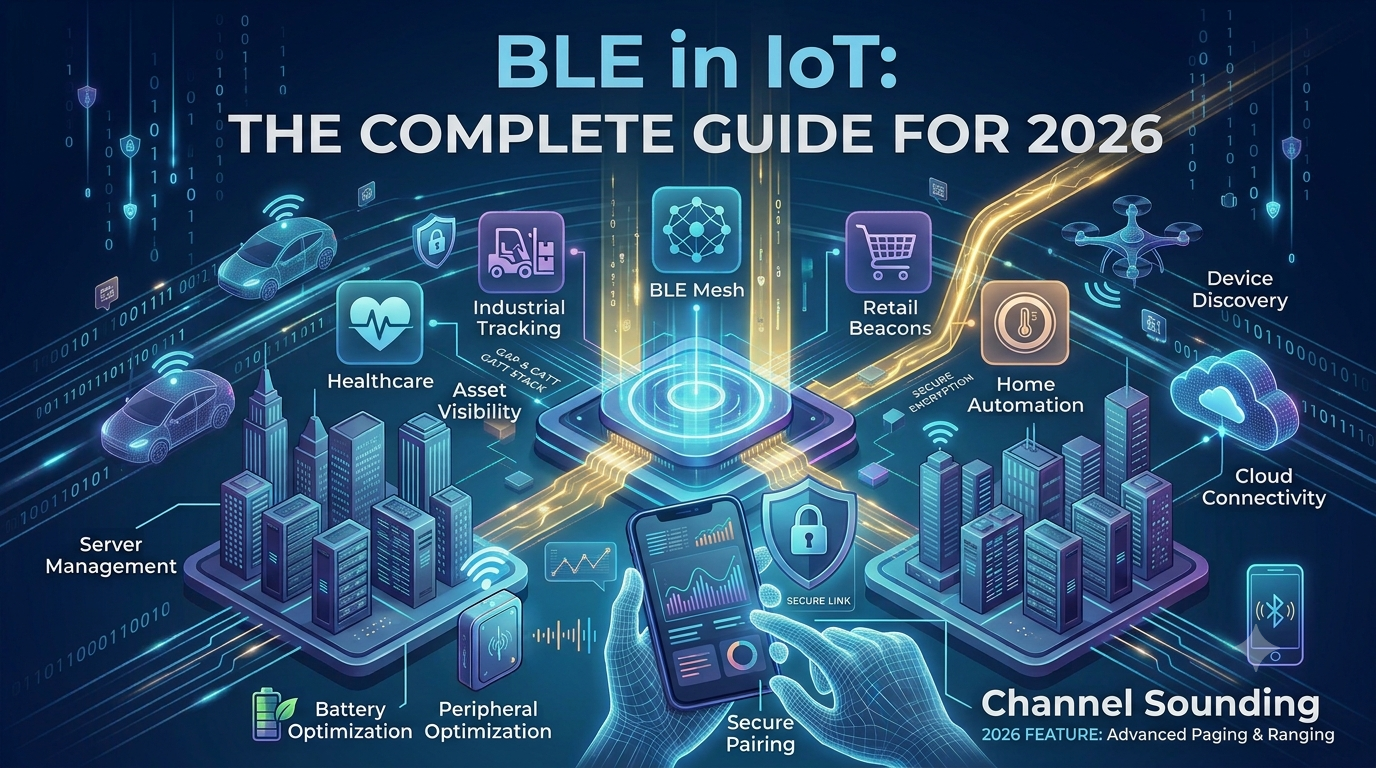
The Internet of Things (IoT) depends heavily on low-power, efficient wireless communication. While cellular, Wi-Fi, and LPWAN handle long-range and high-bandwidth tasks, Bluetooth Low Energy (BLE) dominates short-range IoT deployments—from smart healthcare and industrial asset tracking to smart homes and consumer wearables.
This guide breaks down how BLE powers modern IoT systems, how its architecture works, and why it remains essential in 2026.
What Is Bluetooth Low Energy (BLE)?
Introduced in Bluetooth 4.0, BLE (often called “Bluetooth Smart”) is a radio-frequency technology designed for low-power, intermittent data transmission. Unlike Classic Bluetooth—which continuous streams high-bandwidth data like audio—BLE sends small data packets at specific intervals.
This design lets BLE hardware operate on tiny coin-cell batteries for months or even years without replacement.
Key Benefits of BLE for IoT
- Ultra-Low Power Consumption: Devices sleep when inactive and consume minimal energy during bursts.
- Native Platform Support: Supported natively across virtually all modern smartphones, tablets, and edge gateways.
- Cost Efficiency: Simple integration and low component costs reduce hardware overhead.
- Mesh & Positioning: Supports large-scale device networks (BLE Mesh) and sub-meter positioning (Channel Sounding).
BLE Core Architecture
BLE operates using two core frameworks to discover devices and transfer data:
[ Central Device / Client ]  <--->  [ Peripheral Device / Server ]
      (e.g., Smartphone)                  (e.g., Heart Rate Sensor)
1. Generic Access Profile (GAP)
GAP manages network discovery and connection setup:
- Broadcaster / Observer: One-way data transmission without pairing (e.g., location beacons).
- Peripheral / Central: A peripheral device advertises its presence, and a central device scans for and connects to it.
2. Generic Attribute Profile (GATT)
GATT structures the data exchanged after a connection is made:
- Services: Collections of logical characteristics (e.g., a “Battery” service).
- Characteristics: Individual data values (e.g., current battery level percentage).
Top BLE IoT Use Cases in 2026
- Healthcare & Wearables: Remote patient monitoring via continuous glucose monitors (CGMs) and health trackers syncing to smartphones.
- Industrial IoT & Asset Tracking: High-density BLE tags track inventory, equipment, and cold-chain environmental parameters.
- Smart Cities & Buildings: BLE Mesh connects lighting systems, smart locks, and climate control devices.
- Precision Ranging & Digital Keys: Bluetooth Channel Sounding enables keyless entry systems and accurate indoor navigation.
Classic Bluetooth vs. BLE
| Feature | Classic Bluetooth | Bluetooth Low Energy (BLE) |
| Primary Use Case | Continuous audio / voice / streaming | Sensor readings / short data bursts |
| Power Consumption | High (days) | Ultra-Low (months to years) |
| Data Rate | Up to 3 Mbps | Up to 2 Mbps |
| Network Topology | Point-to-Point | Point-to-Point, Broadcast, Mesh |
Engineering Considerations for BLE IoT
- Power Optimization: Use efficient scan intervals, cache GATT services, and minimize unnecessary connection times to maximize battery life.
- Security: Require encrypted pairing (Passkey/Numeric Comparison) and secure channels to defend against eavesdropping and replay attacks.
- Data Limitations: Keep packet sizes small; route high-bandwidth throughput through Wi-Fi or cellular gateways instead.