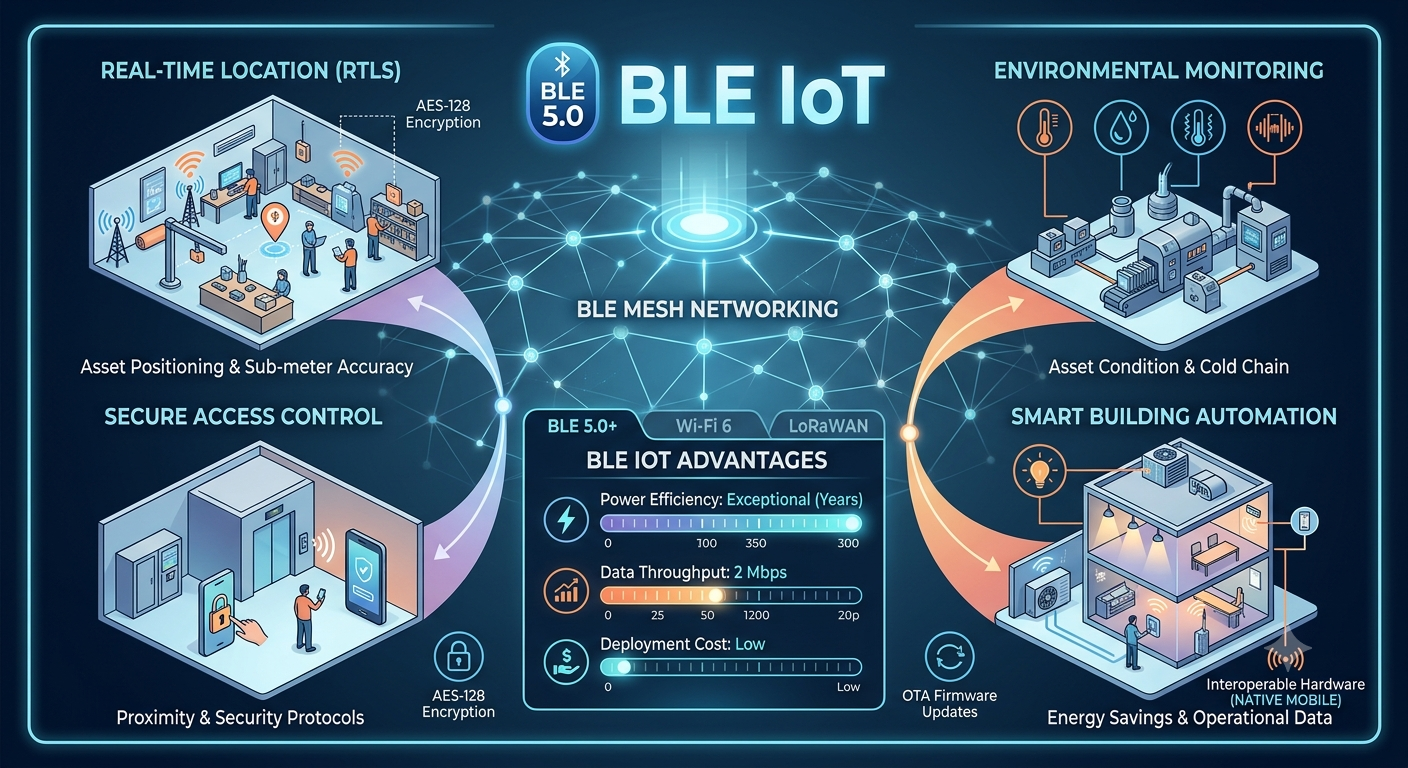
Core Enterprise Applications
1. Real-Time Location Systems (RTLS)
Leveraging Angle of Arrival (AoA) and Angle of Departure (AoD) direction-finding to achieve sub-meter asset tracking across manufacturing facilities, logistics hubs, and healthcare centers.
2. Condition & Environmental Telemetry
Deploying low-cost BLE sensor arrays to monitor temperature, relative humidity, vibration, and pressure across cold-chain assets and critical industrial machinery.
3. BLE Mesh Building Automation
Implementing large-scale, decentralized lighting and HVAC control grids that eliminate dedicated control wiring while providing continuous operational data.
4. Edge Access Control
Utilizing Bluetooth proximity verification for secure, keyless physical access management and automated worker safety monitoring.
Key Technical Advantages for Development Teams
BLE Mesh Topology
BLE Mesh enables true many-to-many ($m:n$) communication networks. By relaying messages across hundreds of node hops without centralized controllers, enterprise networks extend range limitations while eliminating single points of failure.
Native Hardware Interoperability
Because BLE hardware layers are natively integrated into virtually all modern smartphones, tablets, and edge gateways, field engineers can provision, inspect, and update device firmware locally without proprietary diagnostic equipment.
Enterprise Security Framework
BLE IoT architectures incorporate end-to-end security models, leveraging AES-128 encryption, replay-attack protection, anonymous node addressing, and secure out-of-band (OOB) provisioning to satisfy enterprise cybersecurity requirements.
Scaling BLE IoT to Production
Transitioning BLE IoT solutions from proof-of-concept to full enterprise deployment requires robust edge gateways, cloud-based device management systems, and automated Over-the-Air (OTA) firmware pipelines. When designed correctly, BLE IoT infrastructure provides the data layer necessary to drive predictive analytics and optimize modern operational workflows.