The Internet of Things is becoming smaller, smarter, and more connected. From wearable devices and smart buildings to industrial sensors and asset-tracking systems, businesses are looking for wireless technologies that can provide reliable connectivity without creating excessive power or infrastructure requirements.
Bluetooth Low Energy (BLE) has become an important technology for these applications.
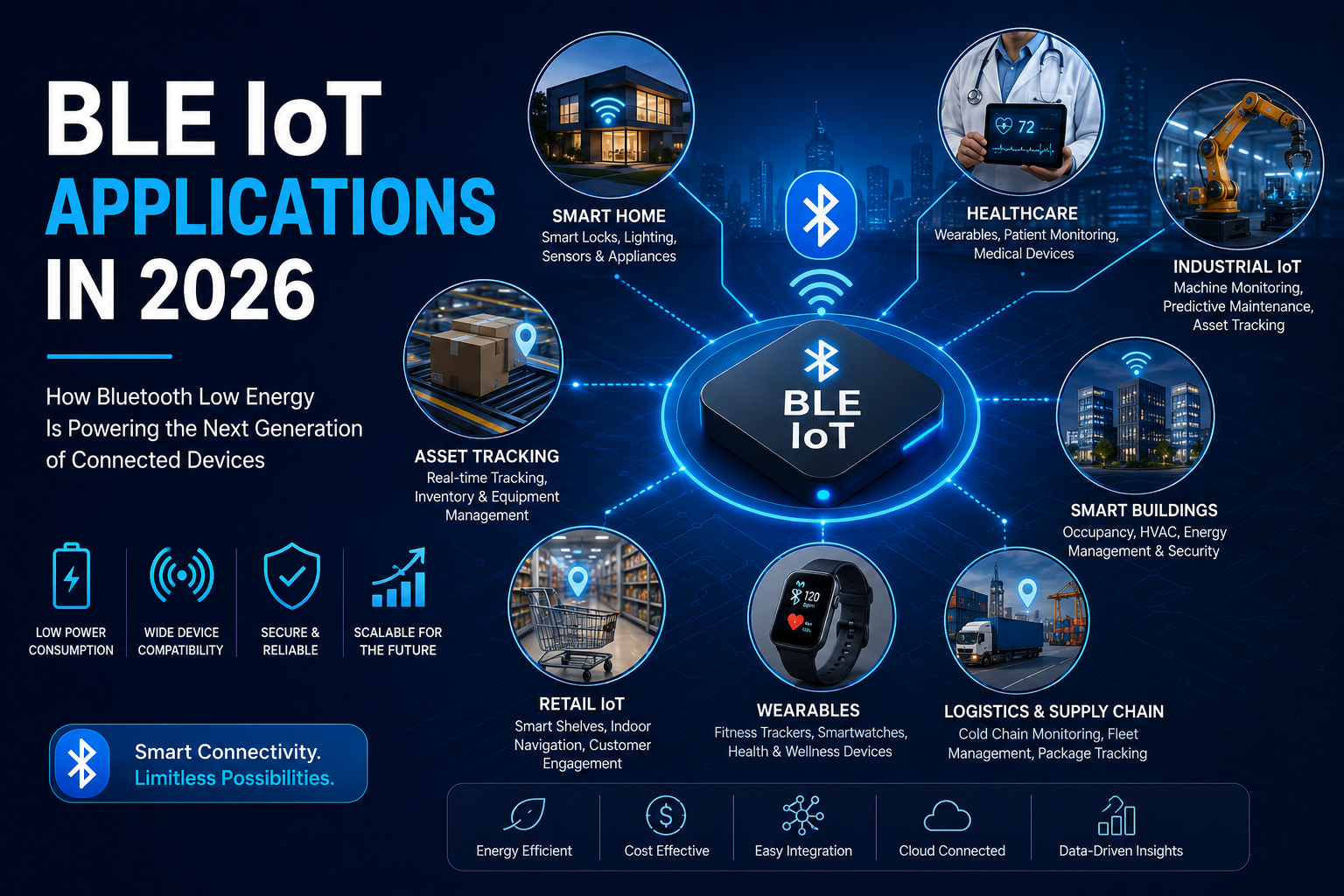
In 2026, BLE is moving beyond traditional wearable and smartphone connections into areas such as healthcare IoT, industrial monitoring, smart buildings, asset tracking, retail, smart homes, and emerging Ambient IoT applications. Industry developments are also expanding BLE’s capabilities for ranging, higher-performance communication, and low-power IoT networks.
What Is BLE IoT?
BLE IoT refers to using Bluetooth Low Energy technology to connect IoT devices, sensors, gateways, mobile applications, and cloud platforms.
A typical BLE IoT system may look like:
BLE Sensor → Smartphone/Gateway → Cloud Platform → Dashboard
For example, a temperature sensor can collect environmental data and transmit it through BLE to a nearby gateway. The gateway can then send that information to a cloud platform where users can monitor the sensor remotely.
BLE is particularly useful when devices need to:
- Consume very little power
- Send small amounts of data
- Operate on batteries
- Connect to nearby devices
- Communicate with smartphones or gateways
- Support large numbers of connected sensors
Bluetooth SIG describes Bluetooth LE as a low-power technology with applications across consumer, commercial, and industrial IoT environments.
Why BLE Is Important for IoT in 2026
IoT developers have many wireless technologies to choose from, including Wi-Fi, cellular, Thread, Zigbee, and LoRaWAN.
BLE stands out for several IoT scenarios because of its low-power operation and broad ecosystem of smartphones, computers, gateways, and embedded devices.
Another advantage is flexibility. BLE can support different network approaches, including point-to-point, star, broadcast, and mesh configurations.
Recent Bluetooth developments are also opening opportunities for more precise ranging, lower communication latency, and increasingly scalable low-power IoT networks.
Top BLE IoT Applications in 2026
1. Smart Home IoT
Smart homes are one of the most familiar applications of connected devices.
BLE can be used in:
- Smart locks
- Motion sensors
- Temperature sensors
- Door and window sensors
- Smart lighting
- Home appliances
- Remote controls
- Presence detection
For example, a BLE smart lock can communicate with a smartphone when the user approaches the door.
BLE can also work alongside Wi-Fi or other networking technologies. A BLE device does not necessarily need to connect directly to the internet; a smartphone, hub, or gateway can act as the bridge.
2. Healthcare and Medical IoT
Healthcare is becoming an increasingly important BLE IoT application.
BLE can connect:
- Wearable health devices
- Patient monitoring sensors
- Fitness trackers
- Smart medical equipment
- Temperature sensors
- Rehabilitation devices
- Wellness devices
Bluetooth SIG highlighted healthcare IoT and wearable technology as an active area in 2026, including applications involving continuous biometric data communication.
BLE can allow devices to collect and transmit data while maintaining low power consumption, which is particularly useful for battery-powered wearable products.
Healthcare applications, however, require appropriate security, privacy, validation, and regulatory considerations.
3. Industrial IoT
Industrial environments contain large numbers of machines, sensors, tools, and other assets.
BLE IoT can support:
- Machine monitoring
- Temperature monitoring
- Equipment tracking
- Predictive maintenance
- Worker safety
- Production monitoring
- Environmental monitoring
- Industrial asset identification
A BLE sensor attached to industrial equipment can periodically transmit information to a nearby gateway.
Combined with analytics and AI, that information can help businesses identify abnormal equipment conditions and improve maintenance planning.
Industry discussions in 2026 are increasingly connecting Bluetooth with predictive maintenance, smart-building management, and industrial tracking.
4. Asset Tracking
Asset tracking is another major BLE IoT application.
Businesses can attach BLE tags to:
- Tools
- Medical equipment
- Warehouse inventory
- Manufacturing equipment
- Containers
- Vehicles
- Retail products
Fixed BLE locators or gateways can detect nearby tags and send information to a location-management platform.
This can help organizations answer questions such as:
Where is the equipment?
When was it last detected?
How frequently is it being used?
Has an asset moved outside its expected area?
Bluetooth technology has long been used for indoor positioning and asset tracking, including applications in warehouses, manufacturing facilities, healthcare environments, construction sites, and educational institutions.
5. Smart Buildings
BLE IoT is increasingly being used to make buildings more intelligent.
Applications include:
- Occupancy monitoring
- Indoor navigation
- Smart lighting
- HVAC optimization
- Air-quality monitoring
- Room utilization
- Access control
- Energy management
For example, BLE sensors can detect occupancy and provide data that helps building systems adjust lighting or temperature.
Bluetooth SIG has also highlighted the use of Bluetooth-connected sensors for air quality, building comfort, and energy-related applications.
6. Retail IoT
Retail businesses can use BLE technology to connect physical stores with digital experiences.
Potential applications include:
- Electronic shelf labels
- Indoor navigation
- Product tracking
- Inventory monitoring
- Customer engagement
- Smart displays
- Asset tracking
- Store analytics
BLE beacons can also help provide location-aware experiences through compatible mobile applications.
Emerging smart-label and electronic-shelf-label applications are among the areas identified as growth opportunities for Bluetooth-enabled IoT devices.
7. Wearable IoT
Wearables remain one of the strongest BLE applications.
Examples include:
- Smartwatches
- Fitness trackers
- Smart rings
- Health sensors
- Sports devices
- Wearable industrial equipment
A wearable can collect information locally and synchronize it with a smartphone or another connected device.
This architecture helps reduce the need for high-power connectivity directly on the wearable.
8. Smart Agriculture
BLE can also contribute to smaller-scale agricultural IoT deployments.
Potential applications include:
- Soil monitoring
- Temperature sensors
- Humidity monitoring
- Equipment tracking
- Greenhouse monitoring
- Livestock-related sensing
BLE gateways can collect information from multiple nearby sensors and forward the data to an internet-connected platform.
For large outdoor deployments requiring very long communication distances, other technologies such as LoRaWAN or cellular IoT may be more appropriate.
9. Logistics and Supply Chain
Supply chains depend heavily on visibility.
BLE IoT can help organizations monitor:
- Inventory
- Containers
- Packages
- Equipment
- Warehouse assets
- Cold-chain conditions
For example, a BLE sensor can monitor temperature inside a storage container while a gateway collects and forwards the information.
The combination of BLE sensors, gateways, cloud software, and analytics can create a connected supply-chain monitoring system.
10. Ambient IoT
One of the most interesting developments around IoT is the emergence of Ambient IoT.
Ambient IoT refers to a class of devices designed to operate with extremely low maintenance requirements, potentially using energy harvested from sources such as light, motion, heat, or radio waves.
Bluetooth SIG identifies Bluetooth LE as an important technology for Ambient IoT because of its low-power characteristics and broad existing ecosystem.
Potential applications include:
- Smart labels
- Connected packaging
- Inventory tracking
- Environmental sensors
- Retail products
- Supply-chain monitoring
This could eventually enable huge numbers of inexpensive connected objects.
BLE IoT Architecture
A modern BLE IoT solution generally contains several layers.
1. BLE Device
The device contains a sensor, microcontroller, BLE radio, and power source.
2. BLE Communication
The device exchanges information using Bluetooth Low Energy.
3. Gateway or Mobile Application
A smartphone, tablet, dedicated gateway, or other connected device receives the BLE data.
4. Cloud Platform
The gateway sends information to a backend platform.
5. Database and Analytics
Collected data is stored and analyzed.
6. User Application
Users can view information through a web dashboard or mobile application.
The complete architecture can therefore look like:
Sensor → BLE → Gateway → API → Cloud → Database → Analytics → Mobile/Web App
BLE vs Wi-Fi for IoT
BLE and Wi-Fi serve different purposes.
| Feature | BLE | Wi-Fi |
|---|---|---|
| Power consumption | Very low | Generally higher |
| Data volume | Low to moderate | High |
| Battery-powered sensors | Excellent | Often less suitable |
| Smartphone support | Excellent | Excellent |
| Internet connection | Usually through gateway/device | Direct |
| Typical applications | Sensors, wearables, tracking | Cameras, high-data devices |
| Network options | Point-to-point, star, broadcast, mesh | Primarily WLAN |
The best technology depends on the application’s range, bandwidth, power requirements, network architecture, and cost.
In many real-world IoT systems, BLE and Wi-Fi can work together rather than compete.
For example:
BLE Sensors → BLE Gateway → Wi-Fi → Cloud
Bluetooth SIG and Wi-Fi Alliance are also working on improved coexistence between the technologies as wireless deployments become denser and more demanding.
BLE IoT and AI
The combination of BLE IoT and artificial intelligence creates another major opportunity.
BLE sensors can collect real-world data while AI systems analyze that information.
For example:
BLE Sensor → Data Collection → Cloud → AI Analysis → Business Action
An industrial sensor could provide equipment data while an AI system identifies unusual patterns.
A smart-building system could analyze occupancy and environmental data to improve energy efficiency.
A healthcare wearable could collect information that supports monitoring and personalized insights.
This combination is helping move IoT from simple data collection toward intelligent decision-making.
BLE IoT Security Considerations
Security should be considered from the beginning of a BLE IoT project.
Important areas include:
- Device authentication
- Secure pairing
- Encryption
- Access control
- Secure firmware updates
- API security
- Cloud security
- Data protection
- Device lifecycle management
IoT security is especially important when connected devices handle personal, healthcare, financial, or business-critical information.
A secure architecture should cover the entire system—not only the BLE connection.
What Businesses Should Consider Before Building a BLE IoT Solution
Before starting development, businesses should define:
Power Requirements
How long should the device operate on a battery?
Communication Range
How far does the device need to communicate?
Data Requirements
How much information does each device need to transmit?
Number of Devices
Will the solution contain 10 devices, 1,000 devices, or millions?
Gateway Requirements
Does the system need a smartphone, dedicated gateway, or direct internet connection?
Cloud Architecture
Where will device data be stored and analyzed?
Mobile or Web Application
How will users interact with the system?
Security
What data needs protection and what authentication mechanisms are required?
Scalability
Can the system support more devices as the business grows?
The Future of BLE IoT in 2026 and Beyond
BLE IoT is moving toward more intelligent, precise, and energy-efficient connected systems.
Bluetooth Channel Sounding is one example of this evolution, bringing more precise distance awareness to Bluetooth-connected devices. Bluetooth Core 6.3 also introduced improvements related to ranging precision, interface capacity, and radio efficiency.
At the same time, Ambient IoT and AI-powered edge systems are creating new possibilities for connected devices that can operate with minimal energy and infrastructure.
This means future BLE IoT products may not simply connect devices.
They may also:
- Understand their environment
- Detect changes
- Determine proximity
- Collect sensor data
- Analyze information locally
- Communicate with cloud platforms
- Trigger automated actions
- Work alongside AI systems
Conclusion
BLE IoT is becoming an important foundation for the next generation of connected products.
From smart homes and healthcare to industrial IoT, asset tracking, smart buildings, retail, logistics, wearables, and Ambient IoT, Bluetooth Low Energy can provide an efficient way to connect sensors and devices.
The biggest opportunity isn’t simply putting BLE into a product.
It is building the complete ecosystem around it:
Hardware + Firmware + BLE + Mobile/Web App + Gateway + Cloud + AI + Security
Businesses that approach BLE IoT as a complete product ecosystem can create connected solutions that are more useful, scalable, and ready for future technology developments.
As IoT continues to evolve in 2026, BLE is positioned to remain an important connectivity layer between the physical and digital worlds.