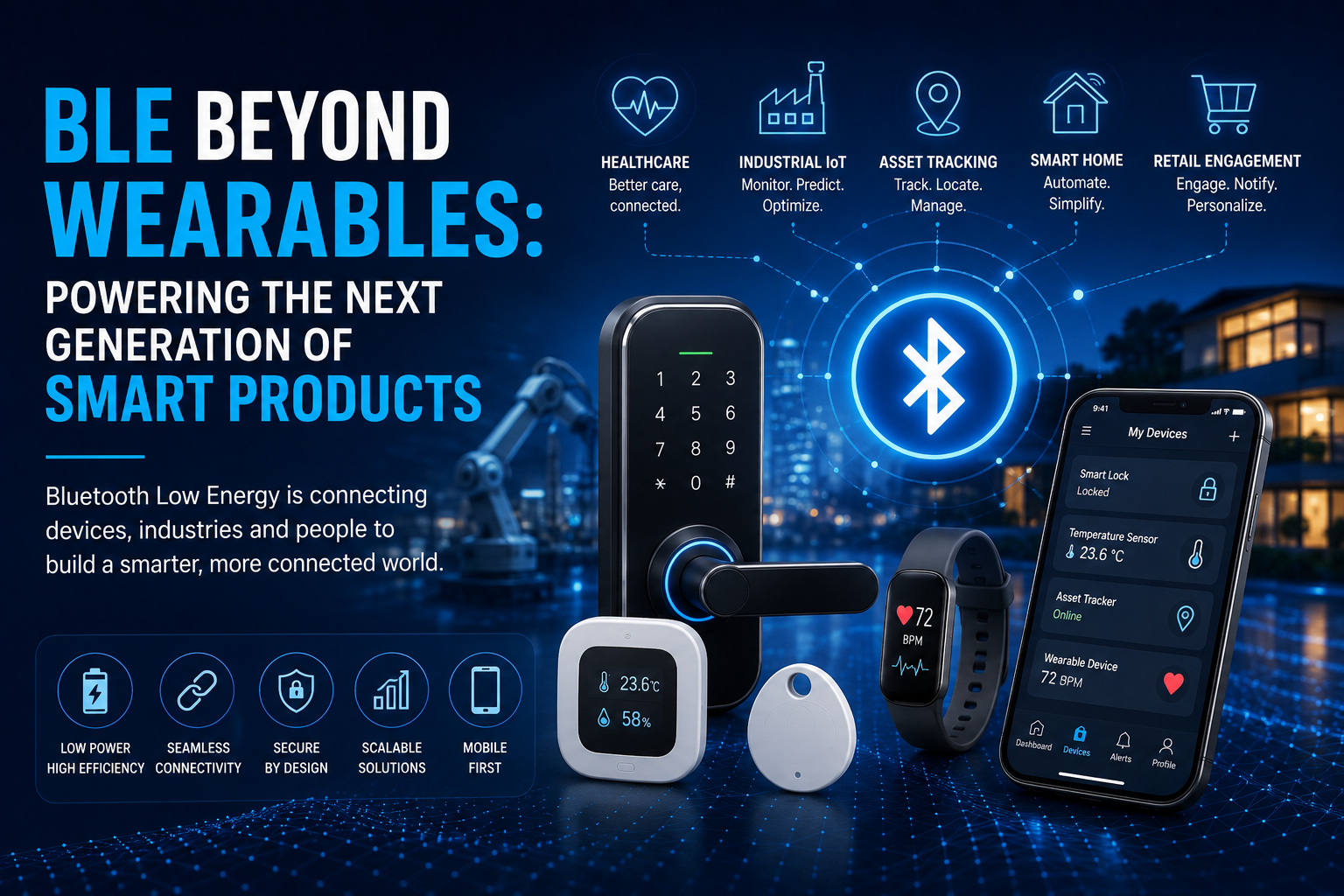
Bluetooth Low Energy, commonly known as BLE, is often associated with smartwatches, fitness bands, and wireless health devices. However, BLE technology has grown far beyond wearables.
Today, businesses use BLE to build smart locks, connected healthcare devices, industrial monitoring systems, asset-tracking solutions, retail experiences, smart home products, and intelligent IoT ecosystems.
The reason is simple: modern connected products need wireless communication that is energy-efficient, reliable, secure, and easy to integrate with smartphones and other devices.
At BLEIoT, we help businesses develop innovative Bluetooth Low Energy and IoT solutions that connect physical devices with mobile applications, cloud platforms, and intelligent digital experiences.
What Makes BLE Different?
Traditional Bluetooth was designed for continuous communication and higher data transfer. BLE was created for devices that need to exchange smaller amounts of information while consuming very little power.
A BLE device can remain in a low-power state for most of the time and become active only when it needs to send or receive data.
This makes BLE suitable for devices that need long battery life.
For example, a small temperature sensor may send a reading every few minutes without using large amounts of energy. Depending on the hardware, configuration, and usage, a BLE device may operate for months or even years on a small battery.
BLE is designed for:
- Low power consumption
- Short-range wireless communication
- Fast device discovery
- Efficient data transfer
- Smartphone connectivity
- Connected IoT products
From Wearables to Smart Business Solutions
BLE technology is now being used across many industries.
Smart Healthcare Devices
BLE can connect healthcare devices with mobile applications and digital platforms.
Examples include:
- Health-monitoring wearables
- Connected wellness devices
- Activity trackers
- Heart-rate monitoring products
- Remote health solutions
- Smart medical equipment
BLE enables devices to transfer information to compatible smartphones or gateways while maintaining efficient battery performance.
Industrial IoT
Industrial companies use BLE-enabled sensors to monitor equipment, environmental conditions, and operational activity.
Possible applications include:
- Machine monitoring
- Equipment tracking
- Temperature and humidity sensing
- Worker safety systems
- Predictive maintenance
- Smart facility management
Connected sensors can provide useful operational data and help businesses identify potential issues earlier.
Smart Homes
BLE supports many connected home experiences, including:
- Smart door locks
- Smart lighting
- Home security sensors
- Connected appliances
- Automated home controls
Users can interact with devices through mobile applications and create personalized automation workflows.
Asset Tracking
Businesses can use BLE tags and beacons to monitor the movement and location of important equipment.
BLE asset-tracking solutions can support:
- Warehouse management
- Inventory visibility
- Equipment tracking
- Workplace asset management
- Logistics operations
Retail and Customer Engagement
BLE beacons can enable location-aware experiences inside stores, shopping centers, events, and other physical spaces.
Businesses may use BLE for:
- Proximity-based notifications
- Indoor navigation
- Personalized customer experiences
- Smart product interactions
- Location-based engagement
Smart Buildings
BLE-enabled sensors can help monitor and manage building environments.
Applications may include:
- Occupancy monitoring
- Energy management
- Smart access systems
- Environmental monitoring
- Connected workplace solutions
How a BLE-Powered Product Works
A complete BLE solution usually includes more than a Bluetooth-enabled device.
A connected product may include:
1. BLE Hardware
The physical device collects information, detects activity, or performs an action.
Examples include sensors, wearables, smart locks, trackers, and connected equipment.
2. Embedded Firmware
Firmware controls the behavior of the device.
It manages communication, sensor activity, power usage, security, and data transfer.
3. Mobile Application
An Android or iOS application connects with the BLE device.
The app may allow users to:
- Discover nearby devices
- Pair devices securely
- View real-time information
- Configure device settings
- Send commands
- Receive alerts
- Synchronize data
4. Cloud Platform
The cloud can store device information and support remote access, analytics, reporting, and centralized management.
5. Web Dashboard
A dashboard allows businesses to monitor devices, review information, manage users, and understand operational activity.
When these technologies work together, a simple connected device can become a complete intelligent product ecosystem.
The Importance of BLE Mobile Applications
A mobile application is often the main connection between users and BLE devices.
A well-designed BLE app should provide a simple and reliable experience.
Important BLE app features may include:
- Device scanning
- Secure pairing
- Automatic reconnection
- Real-time data display
- Device configuration
- Background communication
- Notifications and alerts
- Data synchronization
- Firmware update support
However, BLE development can be complex because device behavior may differ across Android and iOS versions, smartphone manufacturers, and hardware configurations.
Testing is essential to create a stable user experience.
Common Challenges in BLE Development
Connection Stability
BLE connections may be affected by distance, walls, interference, device settings, and operating-system behavior.
Applications should handle connection loss and reconnection smoothly.
Battery Optimization
BLE is energy-efficient, but poor configuration can still reduce battery life.
Developers must optimize:
- Advertising intervals
- Connection intervals
- Data-transfer frequency
- Device sleep modes
- Sensor activity
Device Compatibility
Different smartphones may handle Bluetooth behavior differently.
BLE applications should be tested across multiple devices and operating-system versions.
Data Security
Connected devices may collect sensitive or business-critical information.
Security should be considered across:
- Device firmware
- Bluetooth communication
- Mobile applications
- APIs
- Cloud platforms
- User authentication
Scalability
A prototype may work successfully with one device but face new challenges when deployed across thousands of devices.
Scalable architecture should be planned early in the development process.
How BLEIoT Develops Connected Products
At BLEIoT, we provide end-to-end BLE and IoT development services for startups, businesses, and enterprises.
Our process includes:
Product Discovery
We understand the product idea, target users, technical requirements, hardware capabilities, and business objectives.
BLE Architecture
We plan how the device, firmware, mobile application, cloud platform, and dashboard will communicate.
Mobile App Development
We build Android and iOS applications that connect with BLE-enabled devices and provide intuitive user experiences.
IoT Platform Development
We develop cloud-connected systems for device management, data storage, monitoring, analytics, and reporting.
Device Integration
We connect BLE hardware with mobile apps, APIs, cloud services, and enterprise platforms.
Testing and Optimization
We test:
- Device discovery
- Pairing
- Connection stability
- Data transfer
- Battery performance
- Security
- Cross-device compatibility
Deployment and Support
We support product launches and help businesses improve their connected solutions as requirements evolve.
Why Choose BLEIoT?
BLEIoT provides expertise in:
- Bluetooth Low Energy development
- BLE mobile application development
- IoT application development
- Android and iOS development
- Connected device integration
- Custom web dashboards
- Cloud-based IoT platforms
- Real-time data solutions
- API development
- Smart product development
We focus on building connected solutions that are practical, scalable, secure, and designed for real-world users.
The Future of BLE Technology
BLE will continue to support the growth of connected products.
As businesses adopt more smart sensors, wearables, connected equipment, and intelligent devices, efficient wireless communication will become increasingly important.
The future of BLE may include:
- More intelligent connected devices
- Improved indoor location experiences
- Smarter healthcare products
- Advanced industrial monitoring
- AI-powered device analytics
- More automated IoT ecosystems
- Better integration between devices and cloud platforms
The next generation of connected products will do more than send information. They will analyze conditions, support automation, provide useful insights, and respond to changing environments.
Final Thoughts
Bluetooth Low Energy is no longer only a technology for fitness trackers and smartwatches.
It is helping businesses create smart products, connected applications, intelligent devices, and scalable IoT ecosystems.
From healthcare and industrial automation to retail, logistics, smart homes, and connected workplaces, BLE provides an efficient foundation for modern wireless innovation.
At BLEIoT, we help businesses transform ideas into reliable, secure, and future-ready connected products.
Ready to build your next BLE-powered solution?
Connect with BLEIoT to develop intelligent devices, mobile applications, and scalable IoT platforms.