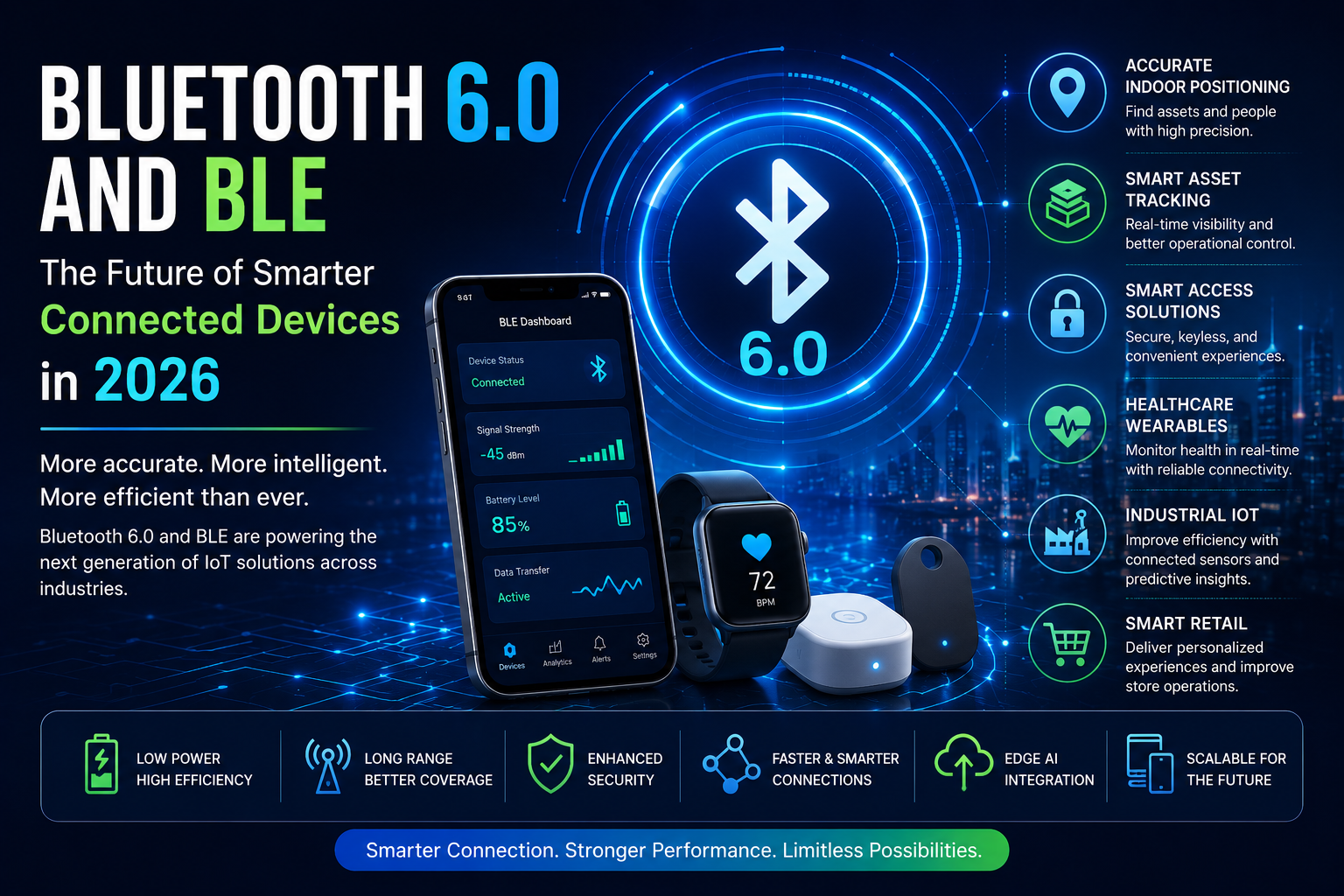
Bluetooth technology is evolving rapidly. From wireless headphones and fitness trackers to medical devices, smart homes, industrial sensors, and asset-tracking systems, Bluetooth Low Energy (BLE) has become an important part of the connected technology ecosystem.
In 2026, businesses are looking for connected solutions that are more accurate, energy-efficient, secure, and responsive. Bluetooth 6.0 introduces new capabilities that can support the next generation of intelligent devices, especially in areas such as location awareness, device discovery, communication efficiency, and connected product development.
For businesses building IoT products, wearable devices, smart applications, or industrial solutions, understanding the future of Bluetooth and BLE can help create more scalable and innovative products.
What Is Bluetooth Low Energy?
Bluetooth Low Energy, commonly known as BLE, is a wireless communication technology designed for devices that need to exchange small amounts of information while using minimal power.
BLE is different from traditional Bluetooth because it is optimized for low-energy communication.
This makes it useful for battery-powered devices such as:
- Smartwatches
- Fitness trackers
- Healthcare wearables
- Smart locks
- BLE beacons
- Asset-tracking tags
- Industrial sensors
- Smart home devices
A BLE device can communicate with a smartphone, tablet, gateway, or another connected device while maintaining efficient battery usage.
What Is Bluetooth 6.0?
Bluetooth 6.0 is a newer generation of Bluetooth technology designed to improve how devices discover, locate, communicate with, and interact with one another.
The technology introduces capabilities that can support more intelligent connected experiences.
Important areas include:
- Improved channel awareness
- Better device discovery
- Enhanced location-based capabilities
- More efficient communication
- Improved connected-device experiences
These capabilities can support applications where accuracy, responsiveness, and efficient communication are important.
Why Bluetooth 6.0 Matters for BLE Development
Bluetooth 6.0 can support the evolution of BLE applications by improving how connected devices operate in complex environments.
Businesses can explore new possibilities in:
- Indoor positioning
- Asset tracking
- Smart access systems
- Healthcare monitoring
- Industrial automation
- Connected retail
- Smart home technology
The technology can help developers create solutions that are more context-aware and responsive.
However, the availability of specific Bluetooth features depends on device hardware, operating systems, chipsets, and software support.
Top Bluetooth and BLE Trends in 2026
1. More Accurate Indoor Positioning
GPS works well outdoors but may be less effective inside buildings.
Bluetooth technology can support indoor location experiences for:
- Hospitals
- Warehouses
- Retail stores
- Airports
- Hotels
- Manufacturing facilities
More accurate positioning can help businesses track assets, guide users, and improve operational visibility.
For example, a hospital may use BLE-enabled tags to help locate important medical equipment.
2. Smarter Asset Tracking
Asset tracking is one of the fastest-growing BLE use cases.
Businesses can use BLE tags and connected applications to monitor:
- Equipment
- Inventory
- Tools
- Vehicles
- Medical devices
- Warehouse assets
A connected platform can display asset information through a mobile application or web dashboard.
Bluetooth improvements can help create more responsive and accurate tracking experiences.
3. Improved Smart Access
BLE technology is increasingly used in:
- Smart locks
- Digital keys
- Office access systems
- Hotel room access
- Vehicle access
- Secure facilities
A smartphone can communicate with a nearby access device and support a convenient keyless experience.
Secure authentication, encrypted communication, device verification, and access controls are important for smart access applications.
4. Advanced Healthcare Wearables
Healthcare wearables continue to evolve.
BLE-enabled devices can support:
- Heart-rate monitoring
- Activity tracking
- Sleep monitoring
- Remote patient monitoring
- Health alerts
- Connected medical devices
Low-power communication helps wearable devices maintain longer battery life.
Healthcare applications should include appropriate privacy, security, and professional oversight.
5. Industrial IoT and Smart Manufacturing
Manufacturers are using BLE sensors to monitor equipment and improve operational visibility.
BLE-enabled industrial solutions can support:
- Equipment monitoring
- Environmental sensing
- Worker safety
- Asset management
- Predictive maintenance
- Production tracking
Connected sensors can send information to nearby gateways, mobile applications, or cloud platforms.
6. BLE and Edge AI
Artificial intelligence is becoming more important in connected devices.
Edge AI allows some data processing to happen on or near the device.
BLE can provide energy-efficient communication between sensors, devices, gateways, and applications.
Together, Edge AI and BLE can support:
- Faster responses
- Lower cloud data usage
- Improved offline functionality
- Real-time device intelligence
- Better privacy controls
For example, a connected sensor may identify an unusual pattern locally and send only an important alert through BLE.
7. Smart Retail Experiences
Retail businesses are using BLE technology to improve customer experiences and store operations.
Possible use cases include:
- Location-aware promotions
- Smart inventory tracking
- Connected POS systems
- Customer engagement
- Digital store experiences
- Asset monitoring
BLE can connect physical retail environments with mobile applications and digital platforms.
Benefits of BLE for Connected Product Development
Low Power Consumption
BLE is designed for efficient communication, making it useful for battery-powered devices.
Mobile Device Compatibility
Many modern smartphones and tablets support BLE, allowing businesses to create connected experiences without requiring separate communication hardware.
Cost-Effective Connectivity
BLE can provide a practical wireless communication option for many IoT products.
Fast Device Communication
BLE can support responsive communication for device setup, monitoring, control, and data transfer.
Scalable IoT Solutions
BLE devices can connect with mobile applications, gateways, cloud platforms, and enterprise systems.
Key Considerations When Building a BLE Application
A successful BLE product requires more than connecting a device to a mobile application.
Development teams should consider:
Device Hardware
The BLE chipset, processor, memory, sensors, and battery affect performance and product capabilities.
BLE Communication Architecture
The solution should define:
- Device discovery
- Advertising
- Pairing
- Services and characteristics
- Data transfer
- Connection management
Mobile App Compatibility
The application should be tested across supported Android and iOS devices.
Security
BLE applications should include appropriate security measures, such as:
- Secure pairing
- Encryption
- Authentication
- Device identity management
- Access controls
- Secure firmware updates
Battery Performance
Power consumption should be tested under real-world conditions.
Scalability
The solution should support future devices, users, features, and integrations.
The BLE Application Development Process
Step 1: Define the Connected Product
The development team identifies:
- Business goals
- Target users
- Device requirements
- Communication needs
- Expected outcomes
Step 2: Select Hardware and BLE Technology
The team evaluates:
- BLE chipsets
- Sensors
- Power requirements
- Communication range
- Device memory
- Processing capabilities
Step 3: Design the BLE Architecture
Developers plan:
- Device discovery
- BLE services
- Data communication
- Mobile integration
- Security requirements
Step 4: Develop the Mobile Application
The mobile app may include:
- Device onboarding
- Connection management
- Real-time data
- Device controls
- Notifications
- User settings
Step 5: Build Cloud and Web Features
Cloud platforms can support:
- Device management
- Data storage
- Analytics
- Remote monitoring
- User management
Step 6: Test the Connected Solution
Testing should include:
- Connection stability
- Communication range
- Battery performance
- Device compatibility
- Data accuracy
- Security
- Real-world conditions
Step 7: Launch and Maintain
Connected products may require:
- Firmware updates
- Mobile app updates
- Security improvements
- Performance monitoring
- New device support
Build Future-Ready BLE Solutions with BLEIoT
At BLEIoT, we help startups and businesses transform connected-device ideas into secure, scalable, and user-friendly products.
Our services include:
- BLE application development
- Bluetooth Low Energy integration
- IoT application development
- BLE firmware development
- Android and iOS app development
- Connected healthcare solutions
- Wearable app development
- Asset-tracking applications
- Smart home development
- Industrial IoT solutions
- Cloud and IoT integration
- BLE testing and maintenance
Whether you are developing a healthcare wearable, smart lock, connected sensor, asset-tracking platform, or industrial IoT solution, our team can help build technology around your product requirements.
Conclusion
Bluetooth technology is helping connected devices become more accurate, intelligent, and responsive.
Bluetooth 6.0 and BLE can support new opportunities in indoor positioning, asset tracking, smart access, healthcare, industrial IoT, retail, and intelligent connected products.
The future of BLE is not only about connecting devices. It is about creating secure, energy-efficient, context-aware experiences that deliver practical value.
Businesses that invest in scalable BLE architecture, strong security, and user-focused application development can build connected products designed for long-term growth.
Ready to build your next BLE-powered product? Connect with BLEIoT and turn your connected-device idea into a scalable digital solution.