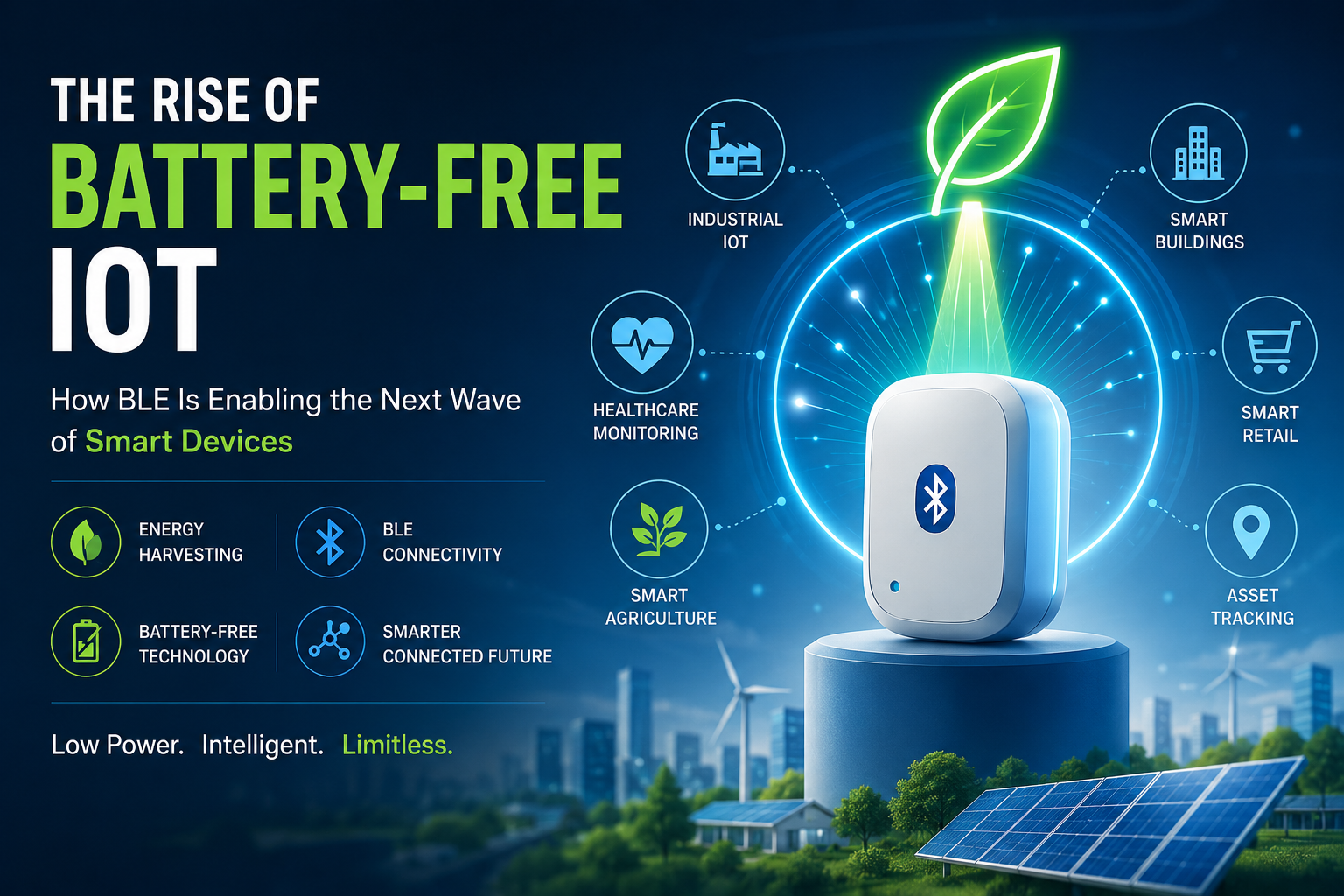
The Internet of Things (IoT) is entering a transformative era. While millions of connected devices already monitor factories, homes, hospitals, and cities, one challenge continues to limit widespread adoption—battery maintenance.
Imagine deploying thousands of sensors across a manufacturing plant or smart city without ever replacing a battery.
This is no longer a futuristic vision.
Thanks to Bluetooth Low Energy (BLE) and advancements in energy harvesting technology, battery-free IoT devices are becoming a reality, unlocking a new generation of sustainable, maintenance-free connected systems. BLE’s ultra-low power characteristics make it one of the leading wireless technologies for energy-constrained IoT deployments.
What Is Battery-Free IoT?
Battery-free IoT devices operate without conventional batteries.
Instead, they collect tiny amounts of energy from their surrounding environment using technologies such as:
- Solar energy
- Indoor lighting
- Radio Frequency (RF)
- Vibration
- Temperature differences
- Motion
This harvested energy powers sensors and BLE communication modules, allowing devices to transmit data without requiring battery replacements.
Why BLE Is the Perfect Technology
Unlike Wi-Fi or traditional Bluetooth, BLE was designed specifically for devices that transmit small amounts of data while consuming extremely little power.
BLE offers:
- Ultra-low energy consumption
- Fast device discovery
- Reliable short-range communication
- Native support on Android and iOS
- Secure encrypted communication
- Long operational life for IoT deployments
These characteristics make BLE ideal for energy-harvesting devices that must operate on only tiny amounts of available power.
Real-World Applications
Smart Buildings
Battery-free occupancy sensors monitor:
- Meeting rooms
- HVAC systems
- Lighting automation
- Energy optimization
Building owners reduce maintenance costs while improving energy efficiency.
Healthcare Monitoring
Medical wearables powered by BLE can monitor:
- Heart rate
- Blood oxygen
- Body temperature
- Patient movement
Low-power BLE enables longer device operation and reliable health monitoring without frequent charging.
Industrial IoT
Factories deploy thousands of sensors to monitor:
- Machine vibration
- Equipment temperature
- Predictive maintenance
- Production efficiency
Battery-free sensors eliminate expensive maintenance schedules.
Smart Retail
Retail stores use BLE devices for:
- Electronic shelf labels
- Customer engagement
- Indoor navigation
- Inventory monitoring
Energy-efficient sensors can operate for years while reducing operational costs.
Agriculture
Smart farming uses BLE sensors to measure:
- Soil moisture
- Temperature
- Humidity
- Irrigation efficiency
Remote farms benefit from maintenance-free monitoring.
The Technology Behind Energy Harvesting
Modern BLE IoT devices combine several components:
- Ultra-low-power BLE chipset
- Environmental energy harvester
- Energy storage capacitor
- Low-power microcontroller
- Intelligent firmware
When enough energy is collected, the device wakes up, gathers sensor readings, transmits data, and returns to an ultra-low-power state.
Security Still Matters
Power efficiency should never compromise security.
Modern BLE IoT solutions include:
- Secure pairing
- AES encryption
- Device authentication
- Secure firmware updates
- Data integrity verification
Security is especially important for healthcare, industrial automation, and financial applications. Recent industry focus has emphasized AI-assisted threat detection and stronger authentication for IoT ecosystems.
Advantages for Businesses
Organizations adopting BLE-powered battery-free IoT gain:
Lower Maintenance Costs
No battery replacement schedules.
Faster Deployment
Thousands of sensors can be installed quickly.
Better Sustainability
Less electronic waste and lower environmental impact.
Improved Scalability
Large sensor networks become easier to manage.
Higher Reliability
Fewer maintenance interruptions lead to improved uptime.
Challenges to Consider
Battery-free IoT isn’t suitable for every application.
Common considerations include:
- Limited energy availability
- Small data transmission windows
- Environmental conditions
- Hardware optimization
- Network planning
Experienced BLE developers carefully design firmware and communication strategies to maximize reliability while minimizing power usage.
Future Trends
The future of BLE IoT is evolving rapidly.
Emerging innovations include:
- AI-powered edge processing
- BLE Mesh networking
- Digital twins
- Predictive maintenance
- Indoor positioning
- Smart warehouses
- Intelligent hospitals
- Sustainable smart cities
Industry forecasts suggest Bluetooth-enabled devices will continue expanding into edge AI, healthcare, retail, and industrial tracking over the coming years.
Why Partner with BLEIoT?
At BLEIoT, we specialize in building secure, scalable, and power-efficient Bluetooth Low Energy solutions tailored to your business.
Our expertise includes:
- Custom BLE Firmware Development
- IoT Device Engineering
- Mobile App Integration
- Cloud Connectivity
- Industrial IoT Solutions
- Healthcare Device Connectivity
- Smart Home Applications
- BLE Mesh Networks
- Asset Tracking Systems
- End-to-End Product Development
Whether you’re creating the next generation of smart wearables, industrial sensors, or connected consumer products, our team helps transform innovative ideas into market-ready IoT solutions.