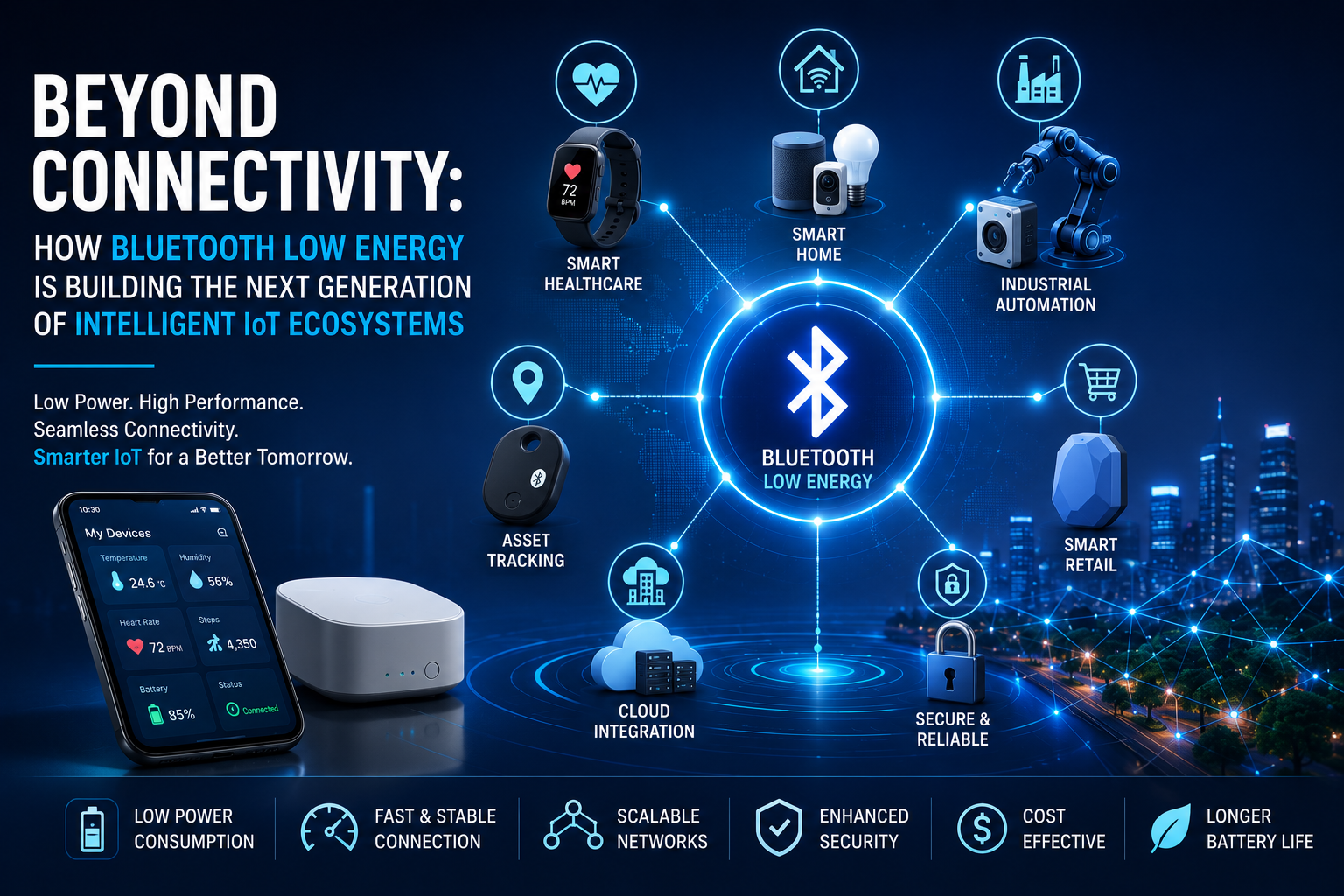
The Internet of Things (IoT) has evolved far beyond simply connecting devices. Today, businesses demand IoT ecosystems that are intelligent, secure, energy-efficient, and capable of operating in real time.
At the heart of this evolution is Bluetooth Low Energy (BLE)—a wireless technology that has become the foundation for millions of connected devices worldwide. From wearable health monitors and smart homes to industrial automation and retail asset tracking, BLE enables reliable communication while consuming minimal power.
As organizations accelerate digital transformation, Bluetooth Low Energy is emerging as one of the most important technologies driving the future of connected products.
Why Bluetooth Low Energy Matters
Traditional wireless communication technologies often consume significant power, making them unsuitable for battery-operated IoT devices.
Bluetooth Low Energy was designed specifically to solve this challenge.
Its key advantages include:
- Extremely low power consumption
- Fast and stable device pairing
- Secure encrypted communication
- Low hardware cost
- Long battery life
- High compatibility with Android and iOS devices
- Easy integration with cloud platforms
These benefits make BLE the preferred wireless technology for modern IoT products.
The Rise of Intelligent IoT Ecosystems
Modern IoT systems are no longer isolated devices—they are interconnected ecosystems where sensors, gateways, cloud platforms, mobile applications, and AI work together seamlessly.
A typical BLE IoT ecosystem includes:
- Smart sensors collecting real-time data
- BLE gateways transmitting information securely
- Mobile applications controlling connected devices
- Cloud dashboards for analytics and monitoring
- AI engines generating intelligent insights
- APIs integrating with enterprise software
This connected architecture enables businesses to automate operations, improve decision-making, and deliver exceptional customer experiences.
Industries Powered by BLE IoT
Smart Healthcare
BLE-powered wearable devices continuously monitor vital signs such as heart rate, oxygen levels, and activity.
Healthcare providers can:
- Monitor patients remotely
- Receive emergency alerts
- Reduce hospital visits
- Improve patient outcomes
Industrial Automation
Factories use BLE-enabled sensors to monitor equipment health, temperature, vibration, and machine performance.
Benefits include:
- Predictive maintenance
- Reduced downtime
- Improved worker safety
- Higher production efficiency
Smart Retail
BLE beacons create personalized shopping experiences by connecting customers with nearby promotions and product information.
Retailers also use BLE for:
- Inventory management
- Indoor navigation
- Customer engagement
- Contactless experiences
Asset Tracking
Companies use BLE tags to locate valuable equipment in warehouses, hospitals, airports, and offices.
Key advantages include:
- Real-time location tracking
- Reduced asset loss
- Faster inventory audits
- Improved operational visibility
Smart Buildings
BLE sensors enable intelligent control of lighting, HVAC systems, occupancy monitoring, and security.
The result is improved energy efficiency and lower operational costs.
Bluetooth Mesh: Expanding the Possibilities
Traditional Bluetooth connects one device to another.
Bluetooth Mesh extends this capability by allowing thousands of BLE devices to communicate within a single network.
This enables:
- Smart city infrastructure
- Large-scale building automation
- Connected street lighting
- Industrial monitoring systems
- Campus-wide IoT deployments
Mesh networking makes BLE ideal for enterprise-scale IoT applications.
Security Is Built into BLE
Security is a major concern for connected devices.
Modern BLE implementations include:
- AES-128 encryption
- Secure pairing
- Authentication mechanisms
- Privacy protection
- Firmware update support
- Device authorization
Combined with secure cloud architecture, BLE helps businesses protect sensitive data and maintain customer trust.
Future Trends in BLE IoT
Bluetooth technology continues to evolve rapidly.
Emerging trends include:
- AI-powered connected devices
- Edge computing integration
- Battery-free IoT sensors
- Digital twins
- Smart logistics
- Precision agriculture
- Connected healthcare ecosystems
- Sustainable energy management
These innovations will enable smarter, more autonomous IoT solutions across industries.
Why Businesses Should Invest in BLE Today
Organizations adopting BLE-powered IoT solutions gain significant competitive advantages:
- Lower operational costs
- Faster automation
- Better customer experiences
- Improved productivity
- Scalable infrastructure
- Long battery life
- Secure device communication
- Future-ready technology
BLE is no longer just a wireless protocol—it’s a strategic enabler of digital transformation.
Why Choose BLEIoT?
At BLEIoT, we specialize in designing, developing, and deploying advanced Bluetooth Low Energy solutions for businesses worldwide.
Our expertise includes:
- BLE Mobile App Development
- Custom IoT Software Development
- Embedded Firmware Development
- Bluetooth Mesh Solutions
- Smart Wearable Applications
- Healthcare IoT Systems
- Industrial IoT Platforms
- Asset Tracking Solutions
- Smart Home Automation
- Cloud IoT Integration
- Device Testing & Certification
- End-to-End Product Engineering
Our experienced team helps startups and enterprises build secure, scalable, and intelligent connected products that deliver measurable business value.
Conclusion
Bluetooth Low Energy is redefining the future of connected technology.
Its combination of low power consumption, secure communication, affordability, and scalability makes it the ideal choice for next-generation IoT ecosystems.
As businesses continue investing in digital transformation, BLE will remain a core technology powering intelligent devices across healthcare, manufacturing, retail, logistics, and smart cities.
If you’re planning to build innovative BLE-enabled products, BLEIoT provides the expertise to transform your ideas into reliable, scalable, and future-ready IoT solutions.