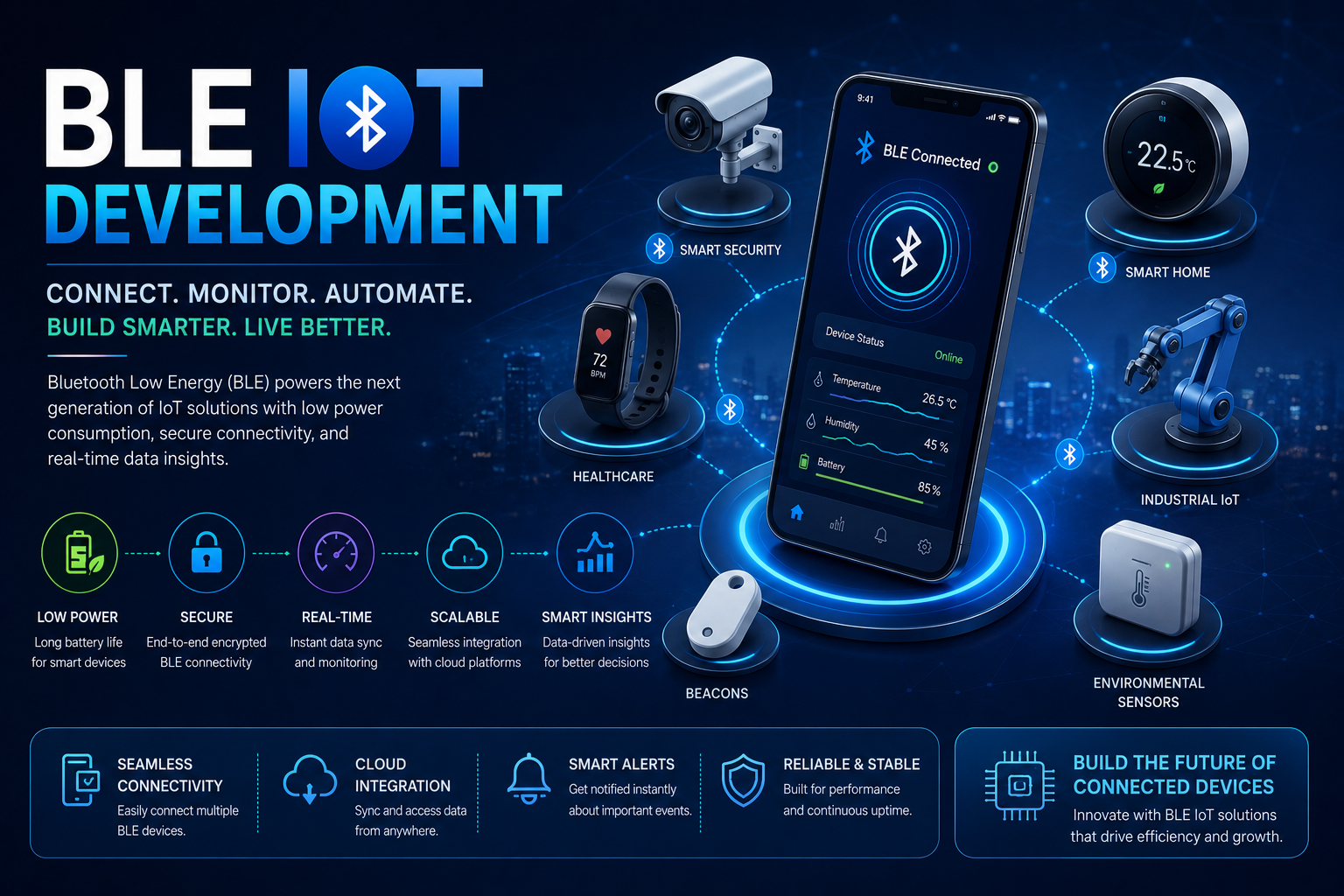
The world is becoming increasingly connected. From smart homes and wearable devices to industrial automation and healthcare monitoring, billions of devices now communicate seamlessly to deliver real-time data and intelligent experiences.
At the center of this connected ecosystem is Bluetooth Low Energy (BLE)—a wireless technology designed for secure, energy-efficient communication between devices.
When combined with the Internet of Things (IoT), BLE enables businesses to build innovative products that are reliable, scalable, and capable of operating for years on minimal power.
Whether you’re developing a wearable health tracker, a smart lock, an industrial sensor, or a retail beacon solution, BLE IoT Development provides the foundation for intelligent, connected products.
In this guide, we’ll explore everything you need to know about BLE IoT development, its applications, benefits, technologies, and why it’s shaping the future of connected devices.
What is BLE IoT Development?
BLE IoT Development is the process of designing, developing, and integrating Bluetooth Low Energy-enabled devices with mobile applications, cloud platforms, and enterprise systems.
Unlike traditional Bluetooth, BLE is optimized for:
- Ultra-low power consumption
- Fast device discovery
- Secure communication
- Continuous sensor data transmission
- Long battery life
BLE IoT solutions typically include:
- Embedded BLE Devices
- Mobile Applications
- Cloud Dashboards
- IoT Gateways
- Analytics Platforms
- Firmware Integration
Why BLE is Ideal for IoT
IoT devices often run on batteries and need to operate continuously for months or even years.
BLE was specifically created for this purpose.
Key Advantages
- Extremely low energy consumption
- Long battery life
- Quick pairing
- Reliable wireless communication
- Low hardware cost
- Secure encrypted connections
- Wide smartphone compatibility
These benefits make BLE one of the most widely adopted communication technologies for IoT applications.
How BLE IoT Works
A typical BLE IoT ecosystem includes:
Smart Device
A BLE-enabled sensor or hardware device collects data.
↓
Mobile App or Gateway
The data is securely transferred to a smartphone, tablet, or IoT gateway.
↓
Cloud Platform
Information is synchronized with cloud servers.
↓
Analytics Dashboard
Businesses monitor devices, receive alerts, and analyze real-time data.
This architecture enables real-time visibility and remote management of connected devices.
Benefits of BLE IoT Development
1. Long Battery Life
BLE devices consume very little power, allowing many devices to function for years without battery replacement.
Ideal for:
- Wearables
- Asset trackers
- Environmental sensors
- Medical devices
- Smart meters
2. Real-Time Monitoring
Monitor critical information instantly:
- Temperature
- Humidity
- Location
- Equipment status
- Heart rate
- Machine performance
3. Cost-Effective Connectivity
BLE hardware is affordable, making large-scale deployments practical for businesses of all sizes.
4. Secure Communication
BLE includes advanced security capabilities such as:
- Secure pairing
- Authentication
- Encryption
- Privacy features
- Device authorization
5. Scalable IoT Ecosystems
BLE solutions can support hundreds or thousands of connected devices through cloud integration and centralized management.
Real-World Applications of BLE IoT
Smart Healthcare
BLE enables:
- Remote patient monitoring
- Smart medical devices
- Medication tracking
- Hospital asset management
- Wearable health monitoring
Retail & Beacons
Enhance customer experiences with:
- Indoor navigation
- Personalized promotions
- Customer engagement
- Contactless shopping
- Queue management
Manufacturing
Improve industrial efficiency through:
- Predictive maintenance
- Machine monitoring
- Worker safety
- Equipment diagnostics
- Production tracking
Logistics & Supply Chain
Track valuable assets using:
- BLE Beacons
- Smart Tags
- Warehouse Monitoring
- Fleet Visibility
- Cold Chain Monitoring
Smart Homes
Control connected devices such as:
- Smart locks
- Lighting
- Thermostats
- Security systems
- Home automation
Agriculture
Monitor:
- Soil conditions
- Water levels
- Crop health
- Livestock tracking
- Greenhouse environments
Must-Have Features in BLE IoT Solutions
BLE Device Discovery
Automatic scanning and pairing with nearby devices.
Secure Data Transmission
Encrypted communication between devices and mobile applications.
Real-Time Dashboard
View connected devices and live sensor data.
Cloud Synchronization
Access information securely from anywhere.
OTA Firmware Updates
Update device firmware remotely without physical intervention.
Smart Alerts
Receive notifications for:
- Device failures
- Low battery
- Temperature changes
- Motion detection
- Connectivity issues
Device Analytics
Analyze:
- Sensor history
- Device health
- Usage statistics
- Operational trends
Industries Using BLE IoT
- Healthcare
- Retail
- Manufacturing
- Logistics
- Hospitality
- Automotive
- Smart Buildings
- Agriculture
- Education
- Energy
- Fitness
- Smart Cities
Technology Stack
Mobile Development
- Flutter
- React Native
- Swift
- Kotlin
Backend
- Node.js
- Python
- Java
- .NET
Cloud Platforms
- AWS IoT Core
- Microsoft Azure IoT
- Google Cloud IoT
Embedded Technologies
- Nordic Semiconductor
- ESP32
- Silicon Labs
- Texas Instruments
- Raspberry Pi
Databases
- PostgreSQL
- MongoDB
- Firebase
Development Process
Step 1
Requirement Analysis
Step 2
Hardware Selection
Step 3
Firmware Development
Step 4
Mobile Application Development
Step 5
Cloud Platform Integration
Step 6
API Development
Step 7
Testing & Validation
Step 8
Deployment
Step 9
Maintenance & Support
AI + BLE IoT
Artificial Intelligence is making BLE devices even smarter.
AI enables:
- Predictive maintenance
- Smart anomaly detection
- Automated decision-making
- Energy optimization
- Predictive analytics
- Intelligent automation
Together, AI and BLE create self-learning connected ecosystems that improve efficiency and reduce operational costs.
Security Best Practices
A secure BLE IoT solution should include:
- End-to-end encryption
- Secure BLE pairing
- Device authentication
- Role-based access control
- Secure cloud APIs
- Firmware signing
- Regular security updates
- Continuous monitoring
Security should be integrated from the earliest stages of development.
Future of BLE IoT
Emerging innovations include:
- Bluetooth Mesh Networks
- AI-powered IoT analytics
- Digital Twins
- Edge Computing
- Smart Factories
- Connected Vehicles
- Smart Retail
- Autonomous Warehouses
- Intelligent Healthcare
- Sustainable Smart Cities
BLE is expected to remain one of the most important wireless technologies powering next-generation IoT ecosystems.
Why Choose QuartusTech for BLE IoT Development?
At QuartusTech, we help businesses transform ideas into intelligent connected products through end-to-end BLE IoT development services.
Our expertise includes:
- BLE Mobile App Development
- IoT Device Integration
- Embedded Firmware Development
- BLE Beacon Solutions
- Wearable App Development
- Smart Sensor Platforms
- Cloud IoT Dashboards
- API Development
- AI Integration
- Long-Term Maintenance & Support
Our team builds secure, scalable, and future-ready BLE IoT solutions tailored to your business requirements.
Final Thoughts
BLE IoT technology is transforming the way businesses connect devices, collect data, and automate operations. Its low power consumption, secure communication, and scalability make it an ideal choice for industries ranging from healthcare and manufacturing to retail and logistics.
If you’re planning to build a connected product, custom BLE IoT Development can help you create innovative solutions that improve efficiency, enhance customer experiences, and drive digital transformation.
Frequently Asked Questions (FAQs)
What is BLE IoT Development?
BLE IoT Development involves creating connected solutions using Bluetooth Low Energy technology for secure, low-power communication between devices, mobile apps, and cloud platforms.
Why is BLE used in IoT devices?
BLE offers low power consumption, long battery life, secure communication, and reliable connectivity, making it ideal for IoT applications.
Which industries benefit from BLE IoT?
Healthcare, retail, logistics, manufacturing, smart homes, agriculture, automotive, fitness, and smart city projects all benefit from BLE IoT solutions.
Can BLE devices connect to the cloud?
Yes. BLE devices typically communicate with a mobile app or gateway, which securely synchronizes data with cloud platforms for monitoring and analytics.
Why choose QuartusTech for BLE IoT Development?
QuartusTech provides end-to-end BLE IoT development, including embedded systems, mobile apps, cloud integration, firmware development, AI-powered analytics, and scalable IoT architectures tailored to your business needs.